Activity Ideas
This page will grow with time, as we build resources for you to try out to address challenges and difficulties that impact your mental health as a kid, child, youth living with epilepsy. Tell us how they went here: info@edmonotnepilepsy.org
USE THE ICONS AND LINKS BELOW
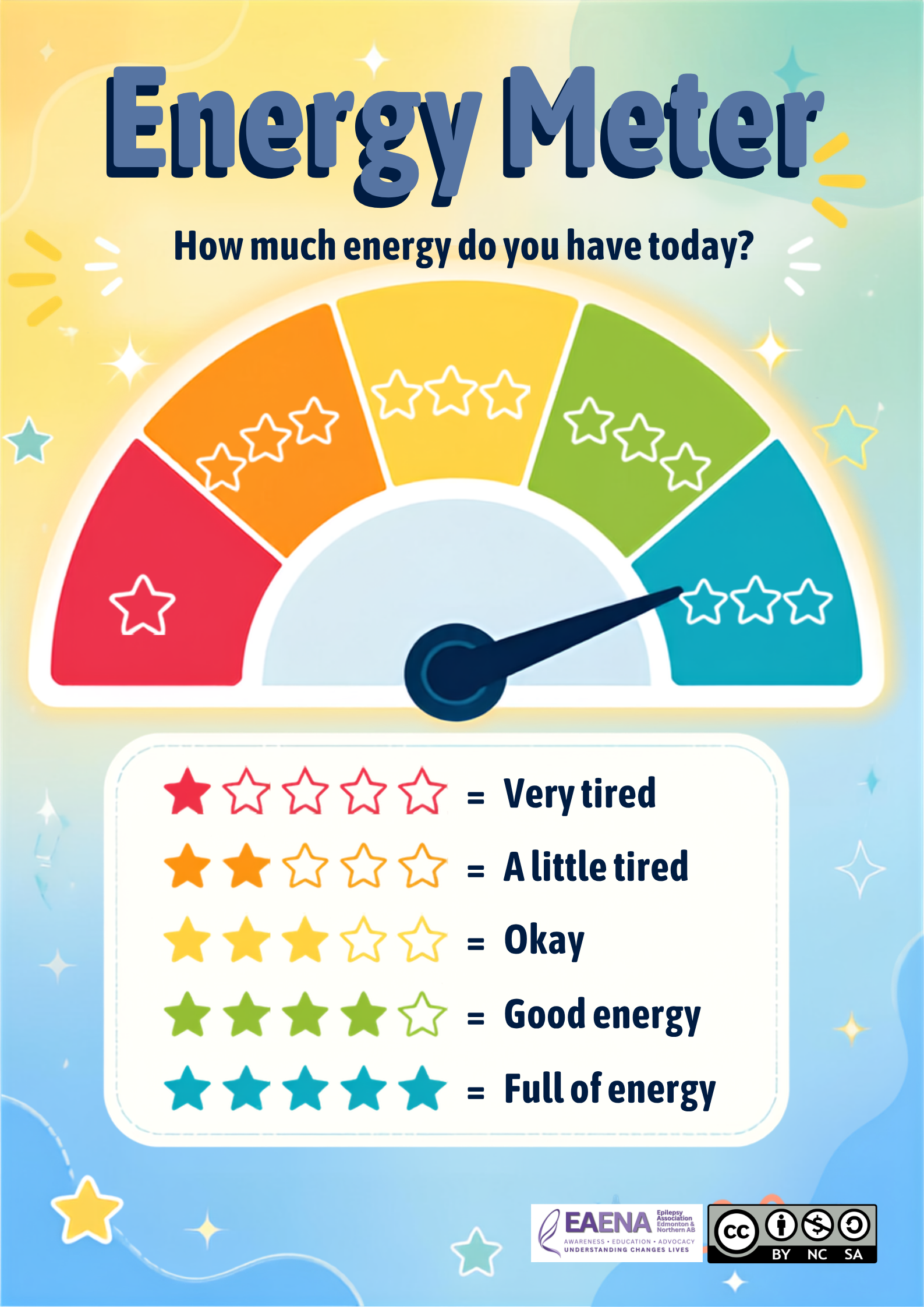
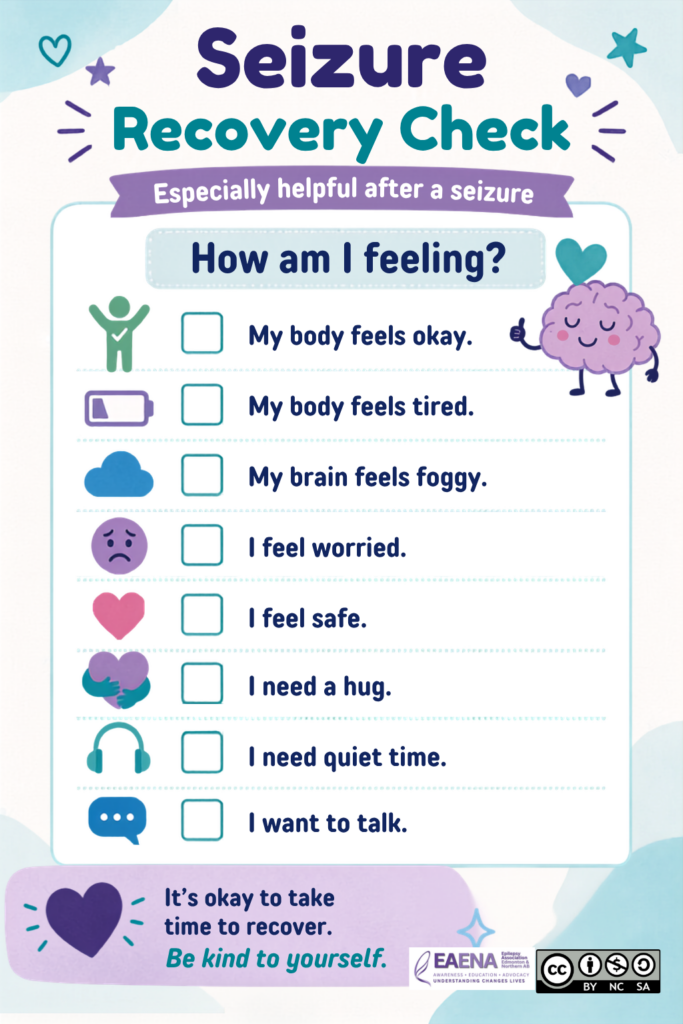
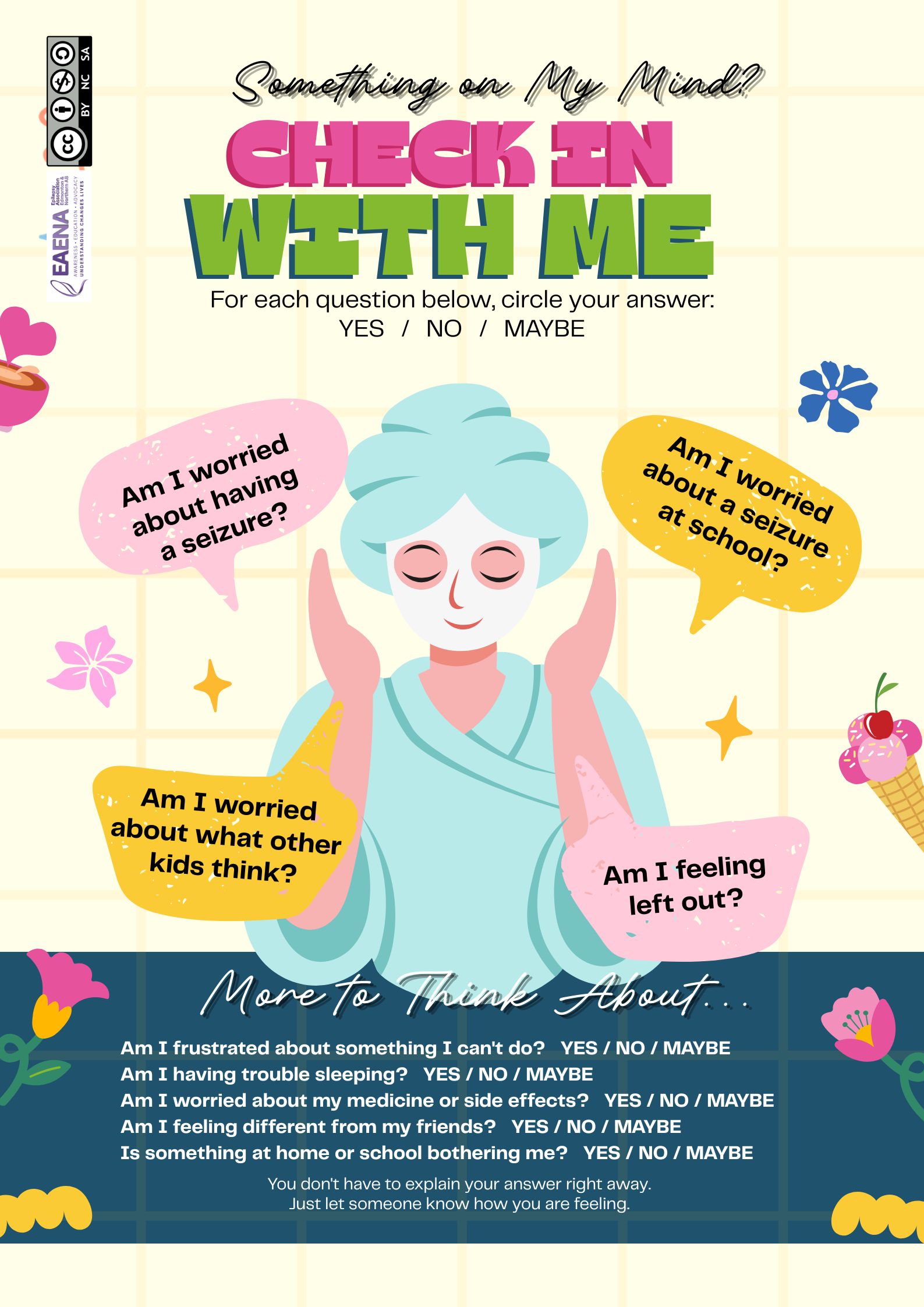
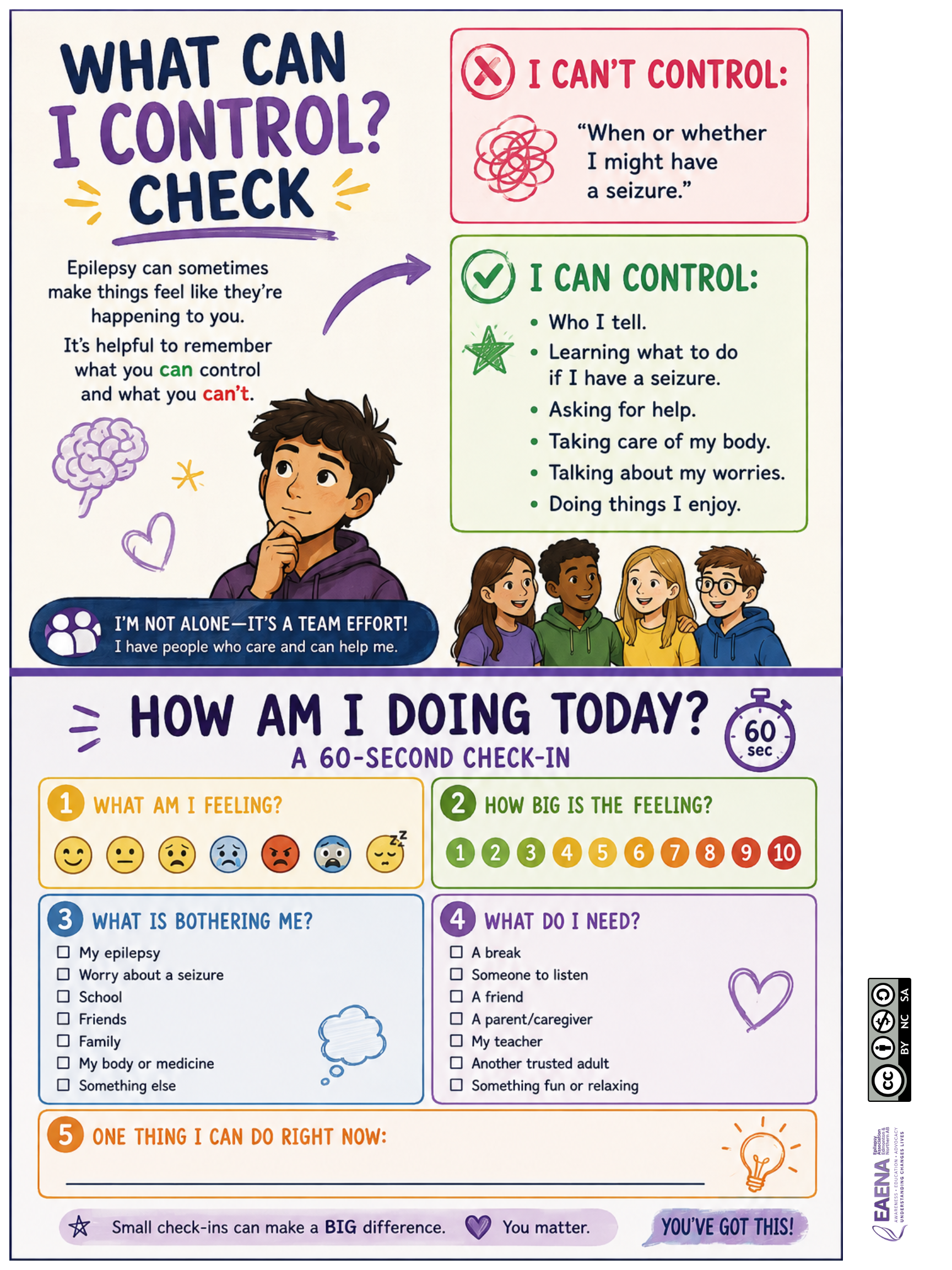
Access and duplicate /use the links below to take emotional and feelings temperature checks, before, after or even just thinking about seizures. Repeat after trying out one of the activities listed on this page. Let us know any comments or observations – email us at info@edmontonepilepsy.org
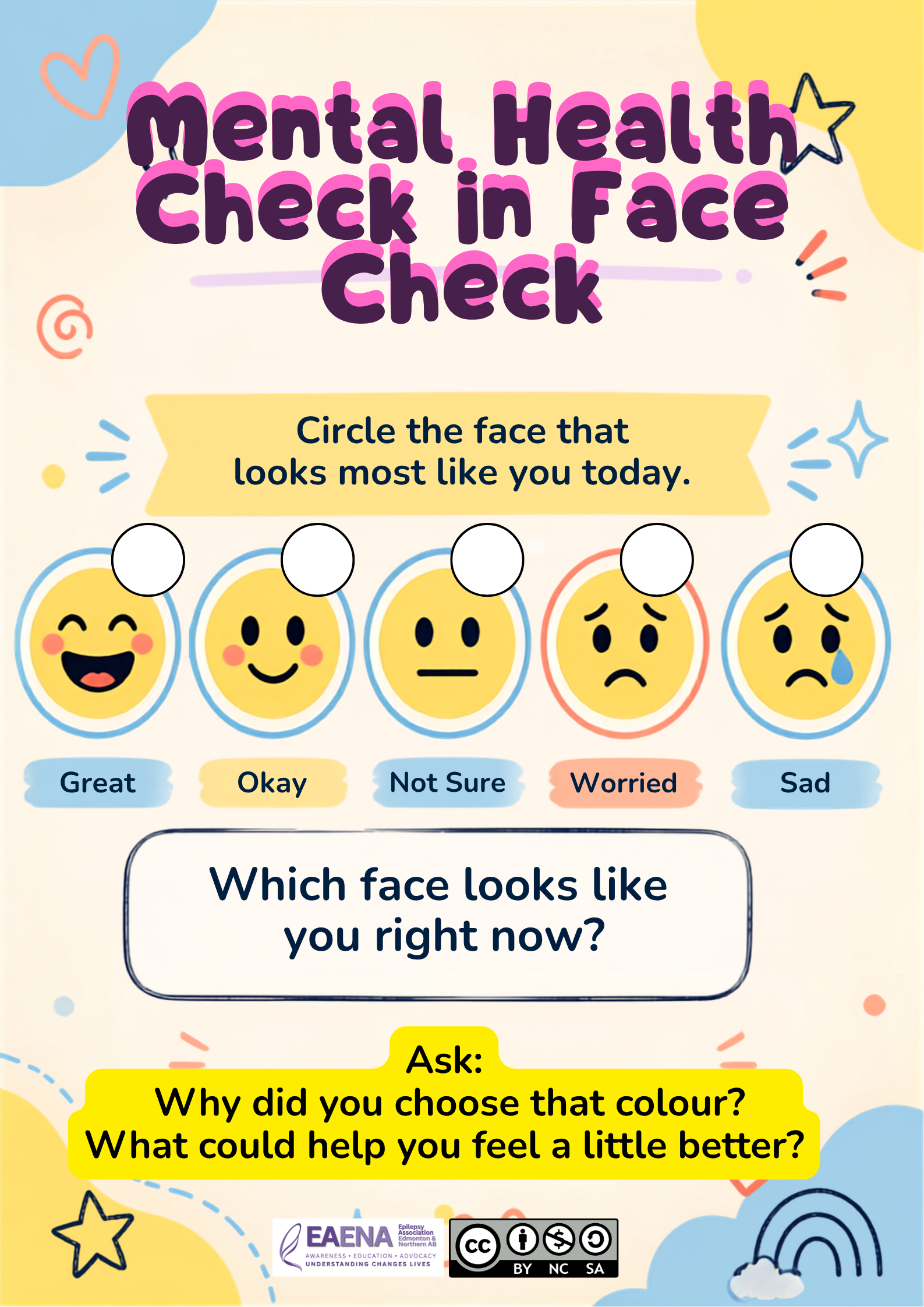
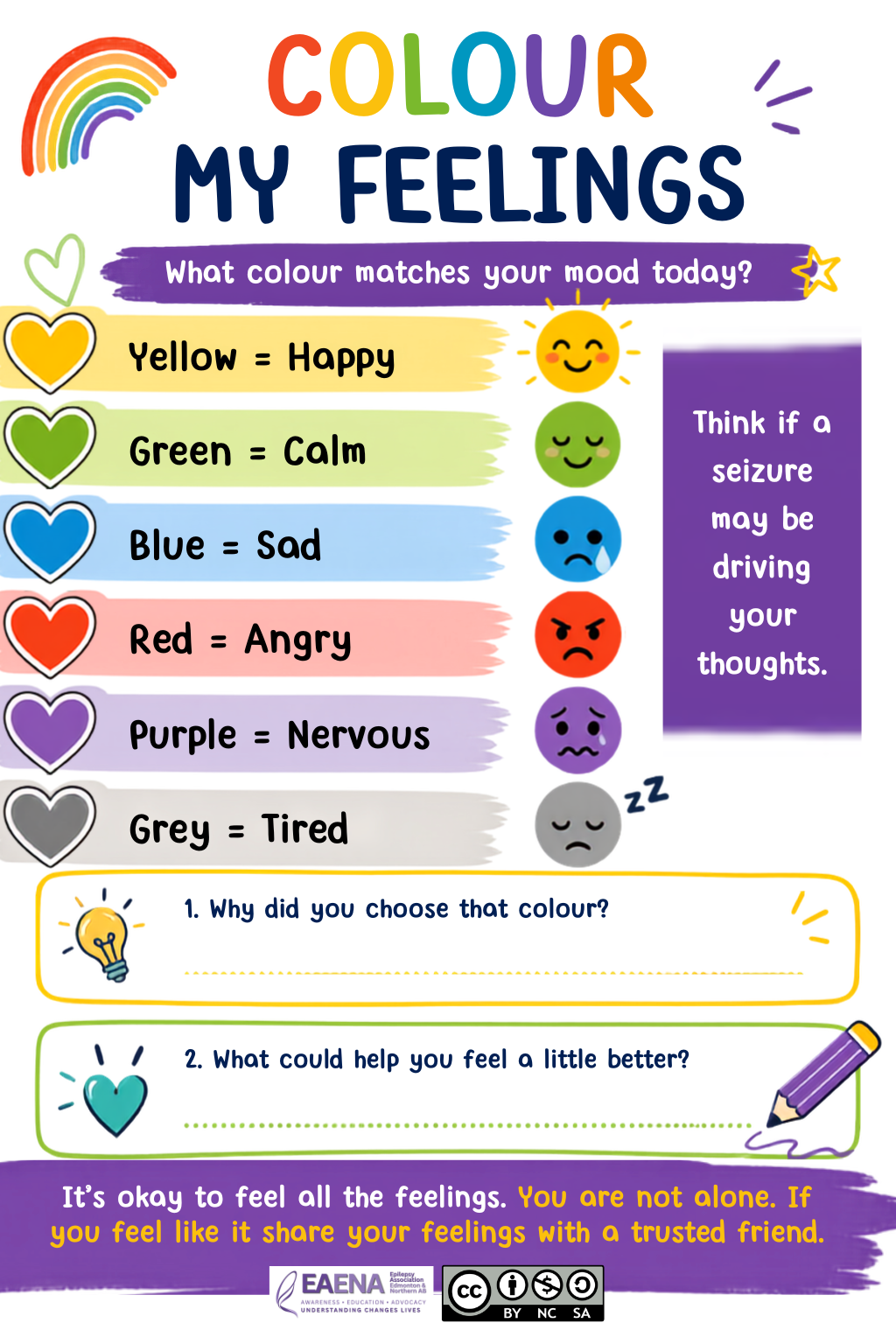
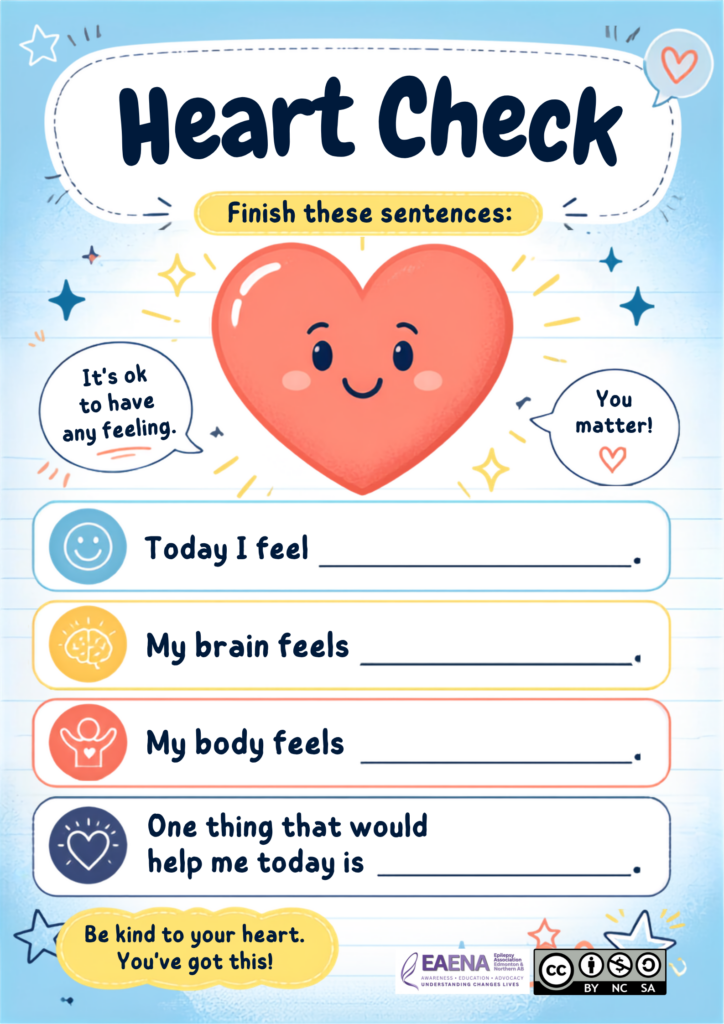
FOR YOUNGER KIDS LIVING WITH EPILEPSY
FOR OLDER KIDS LIVING WITH EPILEPSY
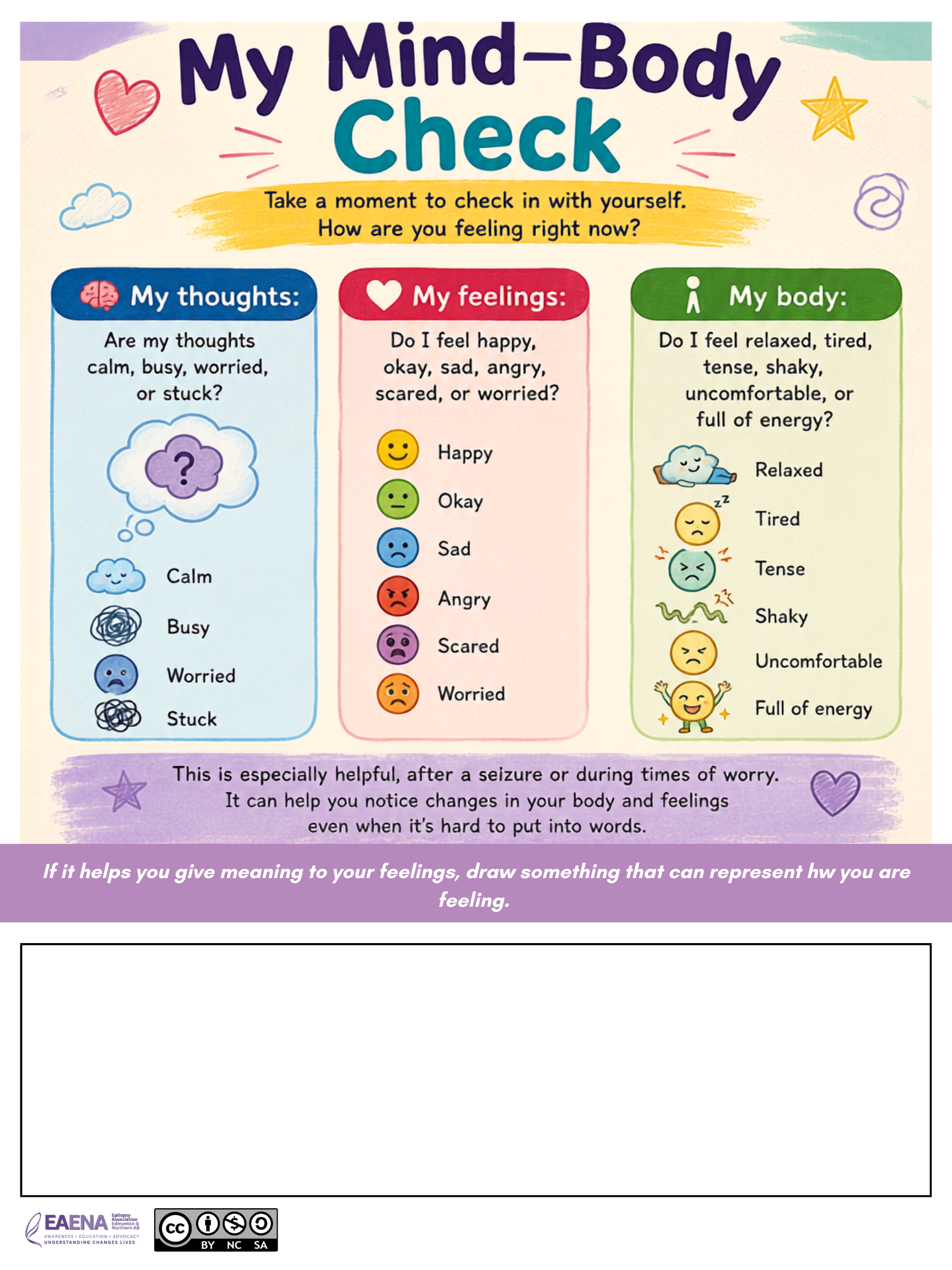
My Body-Mind Check Up
NATURE ACTIVITIES
INDOOR ACTIVITIES
 Step Outside:
Give Your Brain a Break
 CLICK ON THE IMAGE TO SEE IT LARGER.
CLICK HERE FOR THE PDF TO PRINT OUT
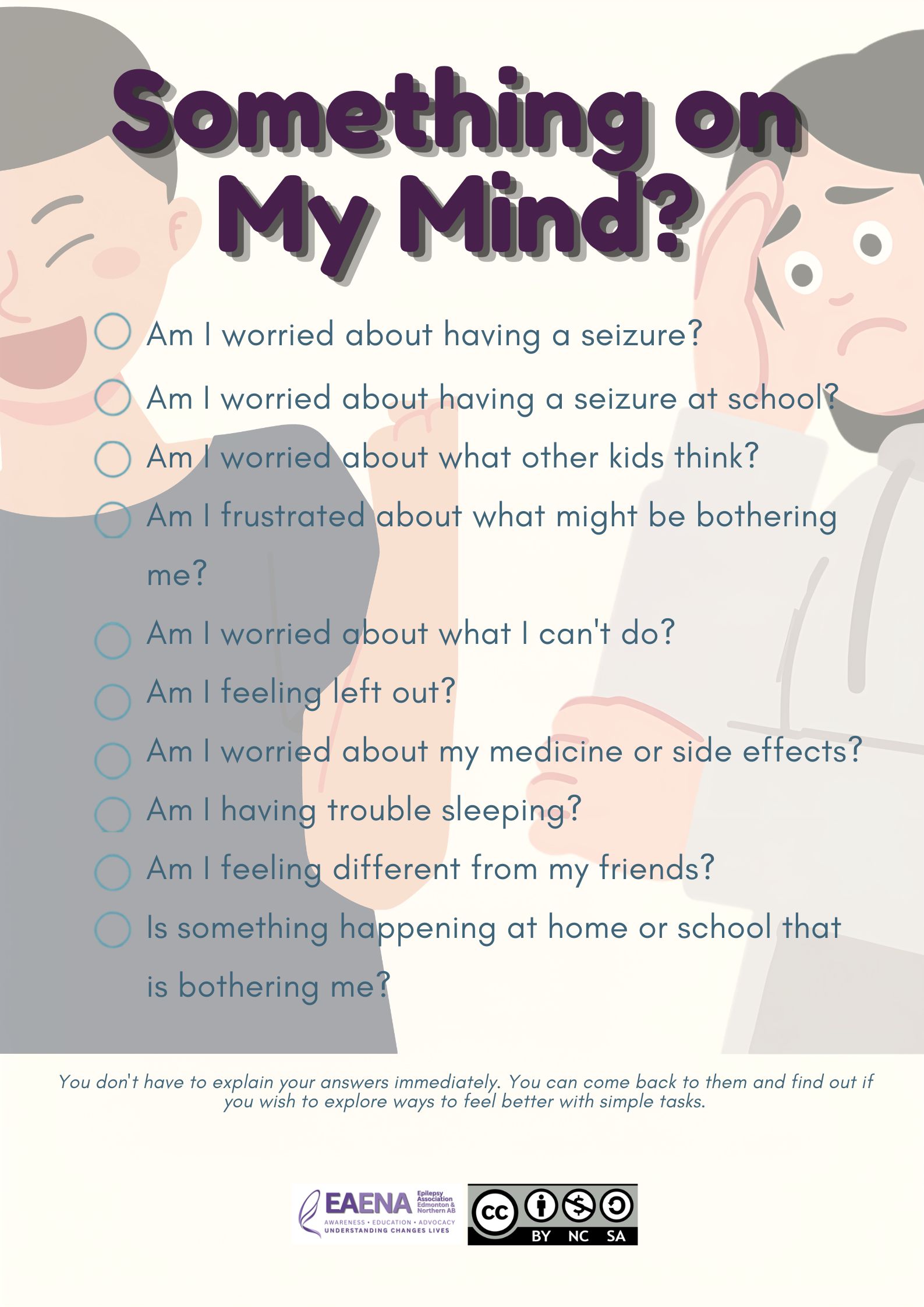
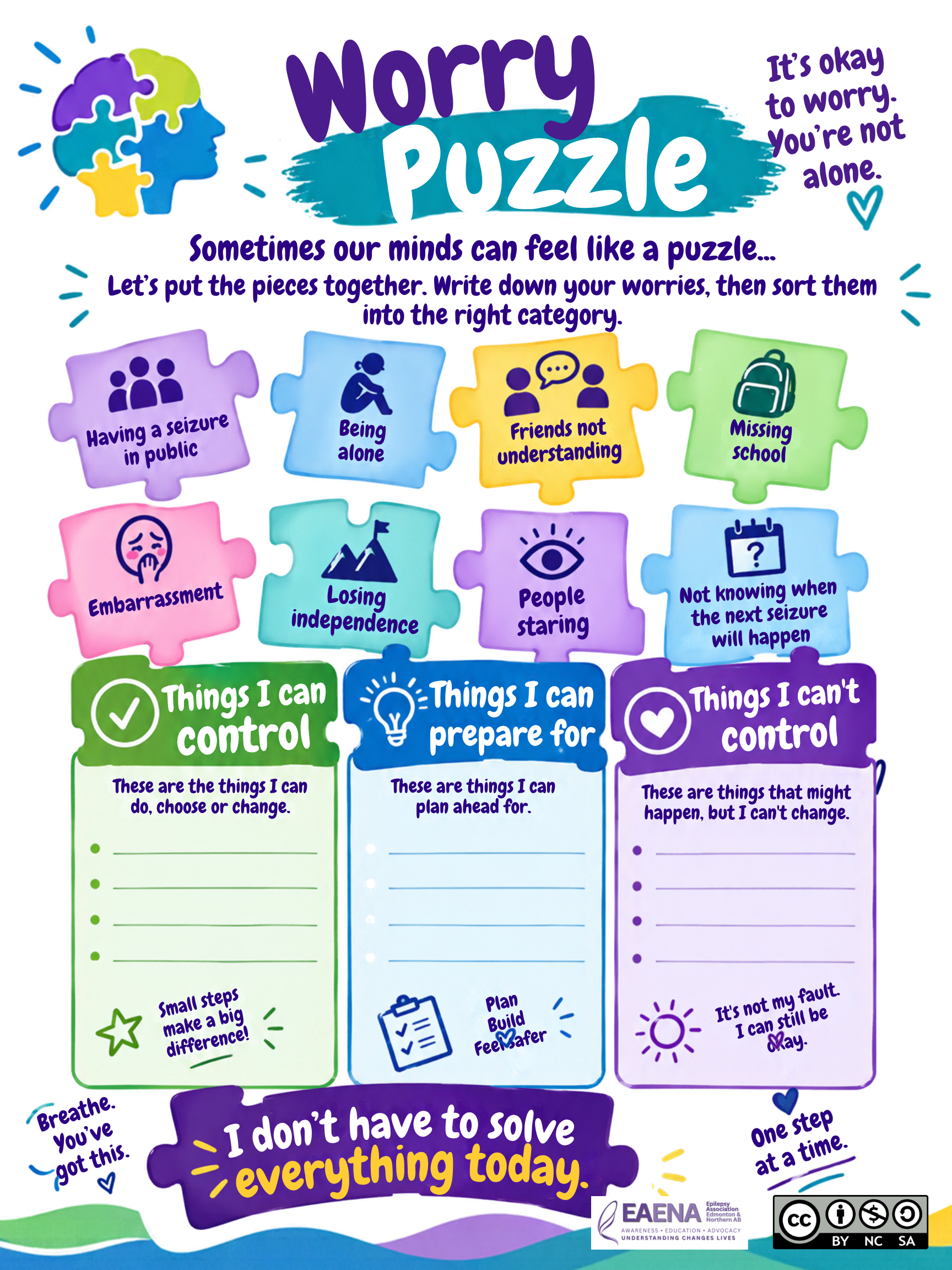
“What if it happens at school?”
“What if people notice?”
“Is that feeling a sign that a seizure is coming?”
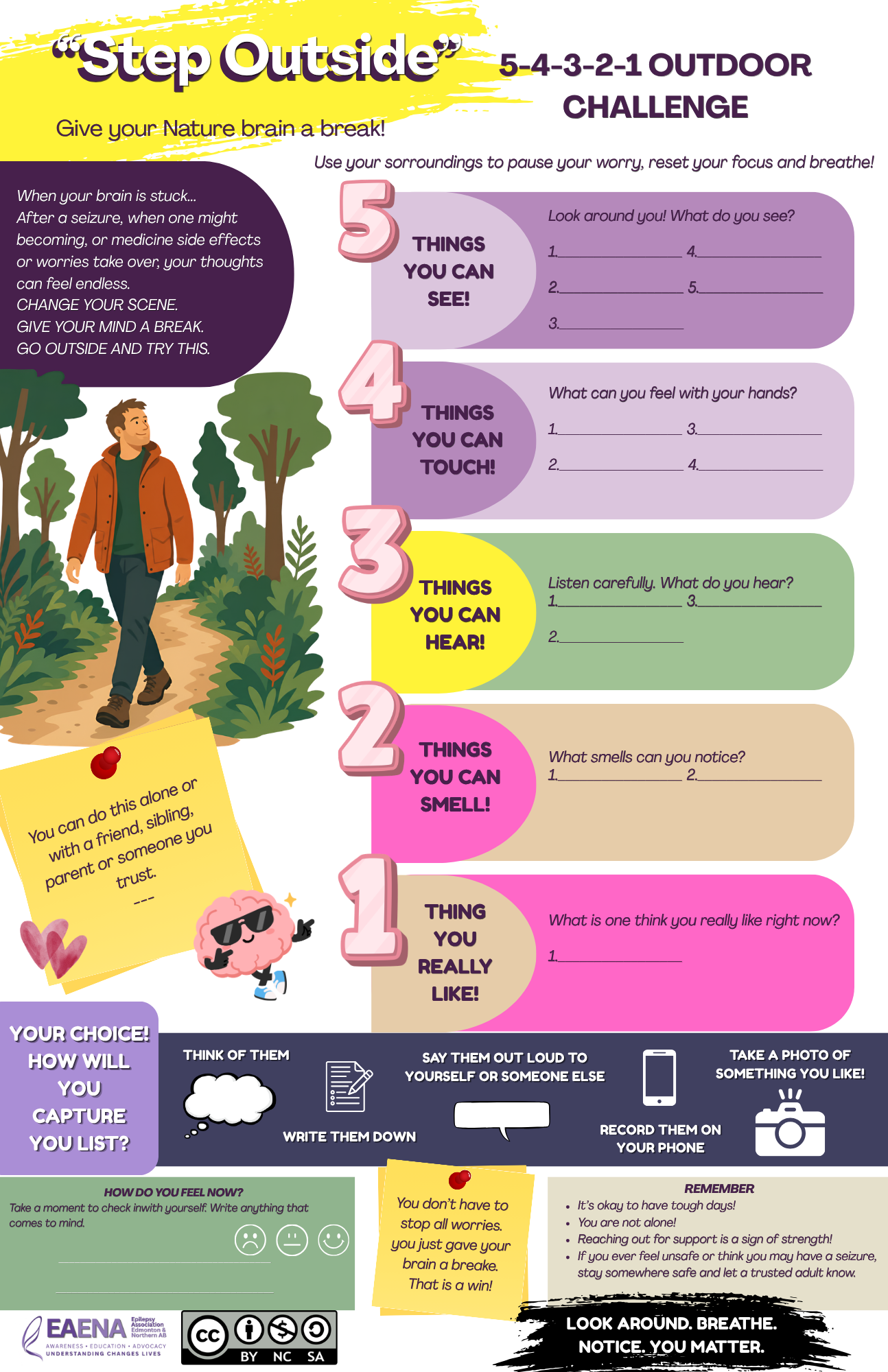
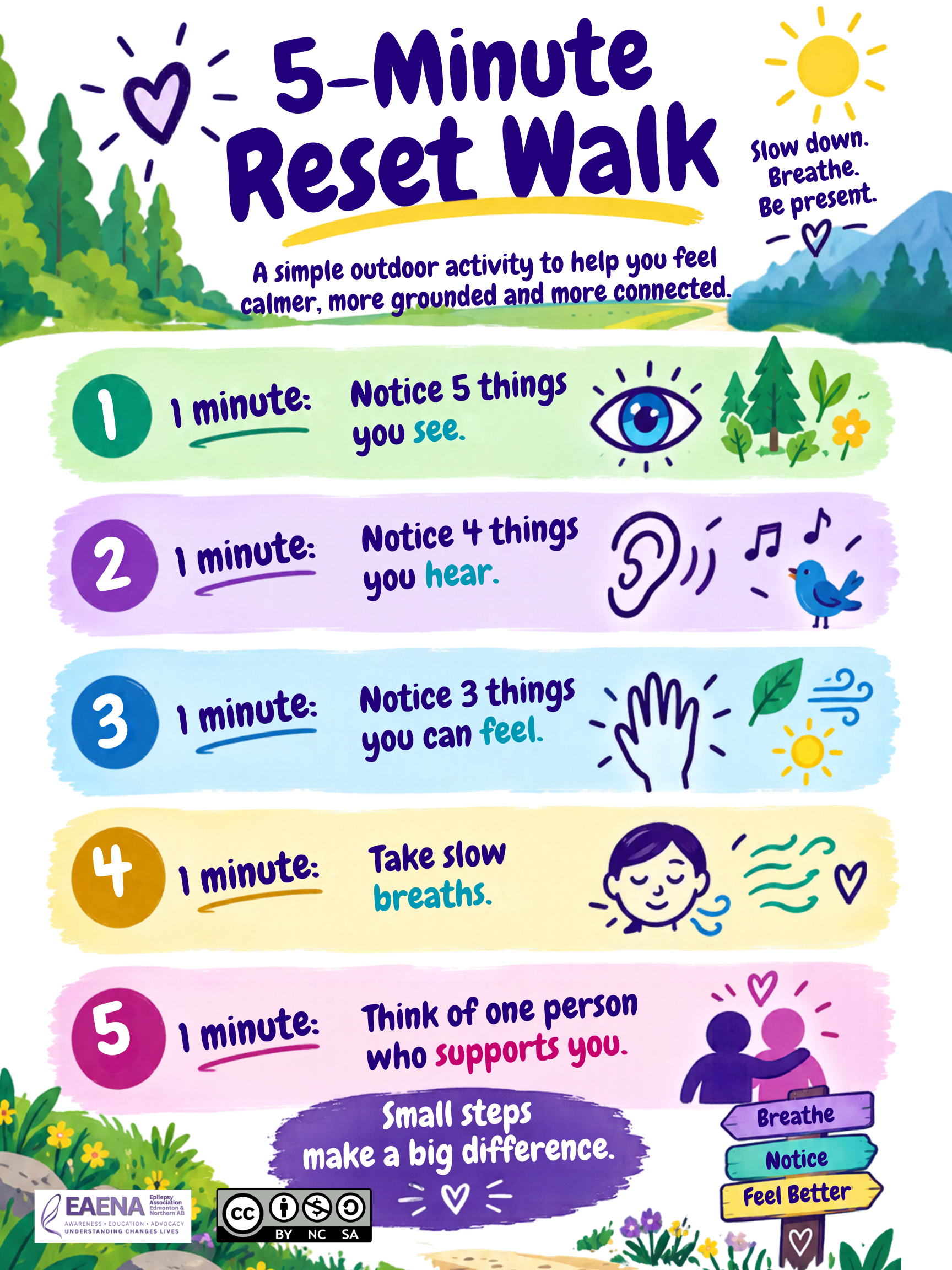
Look around. Find five things you can see. Maybe a tree, a bike, a cloud, someone’s shoes, or a bird.
Notice four things you can safely touch. Maybe the grass, a tree, your jacket, or a bench.
Listen carefully. Maybe you hear birds, cars, people talking, wind, or your own footsteps.
What smells can you notice? Fresh grass? Flowers? Rain? Your lunch?
This one is completely up to you. It could be your favourite song, your dog, a person you care about, your favourite food, a place you love, or simply being outside.
Your thoughts can be loud. That doesn’t mean you have to listen to all of them.Step outside. Look around. Breathe. Notice. Give your brain a break.
Step Outside:
Take a Listening Walk
CLICK ON THE IMAGE TO SEE IT LARGER.
CLICK HERE FOR THE PDF TO PRINT OUT
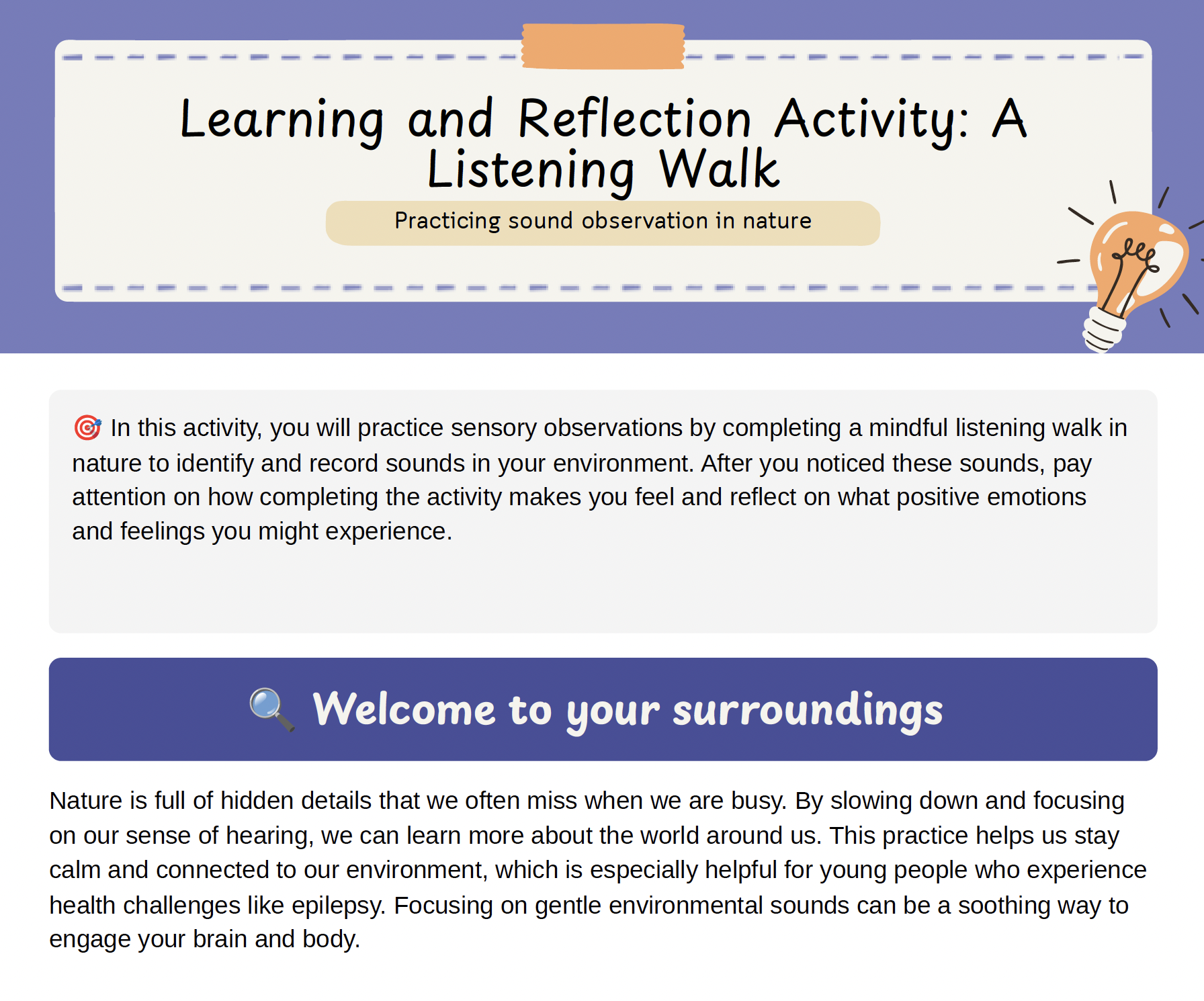
In this activity, you will practice sensory observations by completing a mindful listening walk in nature to identify and record sounds in your environment. After you noticed these sounds, pay attention on how completing the activity makes you feel and reflect on what positive emotions and feelings you might experience. The PDF can be printed out as an activity in a classroom or on your own.
🌬️ Why “Wind Breathing” Can Help Kids with Epilepsy When They Feel Anxious
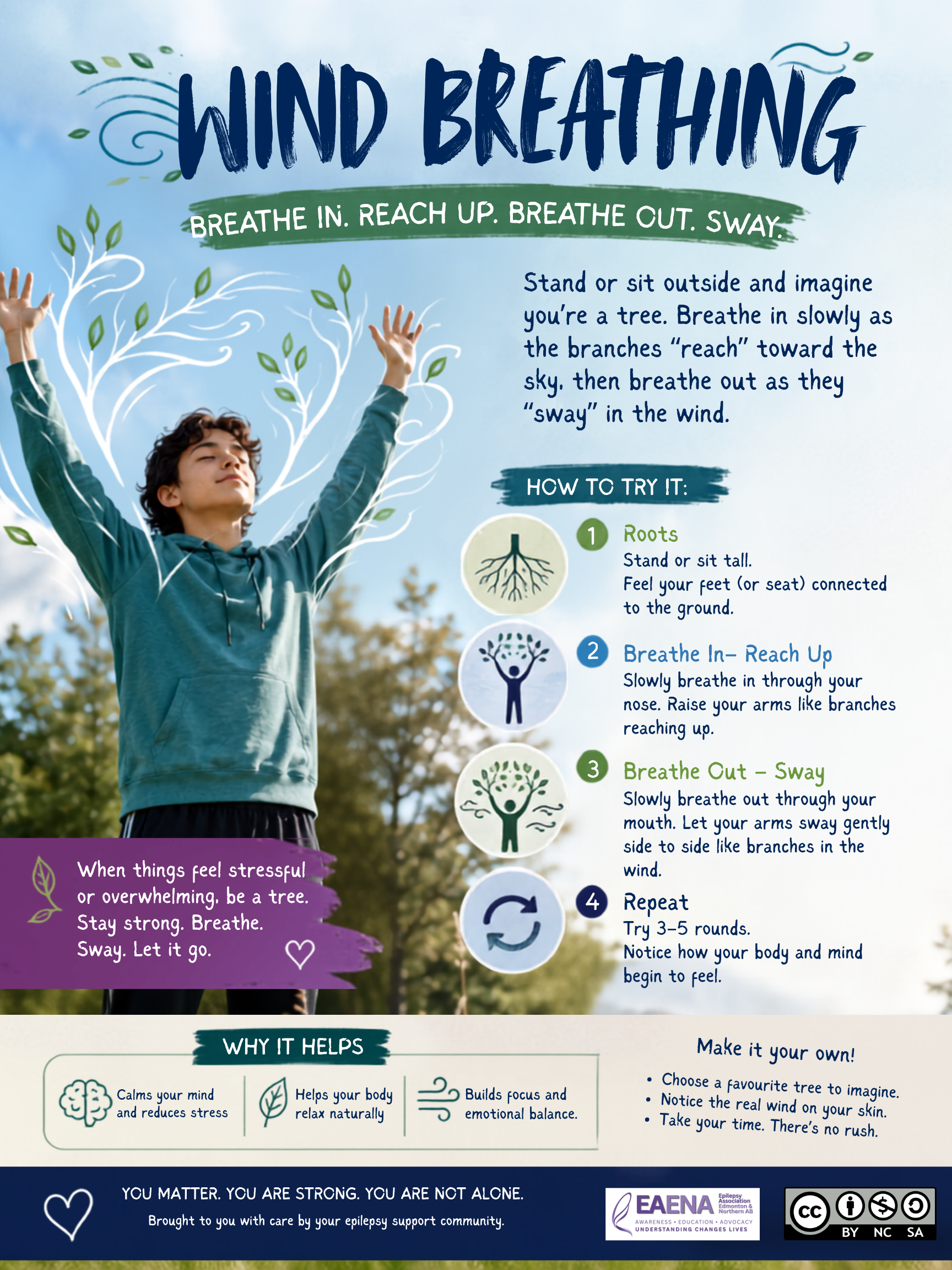
Wind Breathing is a simple, gentle activity that combines slow breathing, imagination, and movement. It can be especially helpful for children with epilepsy who experience anxiety because it gives them something calming and predictable to focus on.
🌿 How it can help
Encourages slow, steady breathing: Slowly breathing in and out can help a child move away from rapid, tense breathing that can happen when they are anxious.
Helps the body relax: Pairing breathing with gentle movements—like imagining tree branches reaching up and swaying—can release physical tension and encourage a calmer body.
Shifts attention away from worry: Focusing on the imaginary wind, trees, and movement gives the child’s mind something simple to concentrate on rather than anxious thoughts.
Creates a sense of control: Anxiety can make children feel that things are happening to them. Wind Breathing gives them an activity they can choose to start and stop, helping them feel more in control.
Uses nature as a calming focus: Being outdoors and noticing the breeze, trees, sounds, and surroundings can provide gentle sensory input and encourage mindfulness.
Easy to remember: A child can use the technique at home, at school, or outdoors without needing special equipment.
💜 An important epilepsy note
Wind Breathing does not treat epilepsy or prevent seizures, but it can be a useful tool for managing feelings of anxiety and helping a child feel calmer. Anxiety and stress can also be difficult experiences for children living with epilepsy, so teaching several healthy coping strategies can be valuable.
For children who may be sensitive to breathing exercises, keep the breathing comfortable and natural. There is no need for deep, forceful, or prolonged breaths. The goal is simply slow, gentle breathing—not taking the biggest breath possible.
A simple message for kids:
🌬️ “Breathe in like the tree is growing tall. Breathe out like the branches are gently swaying in the wind.”
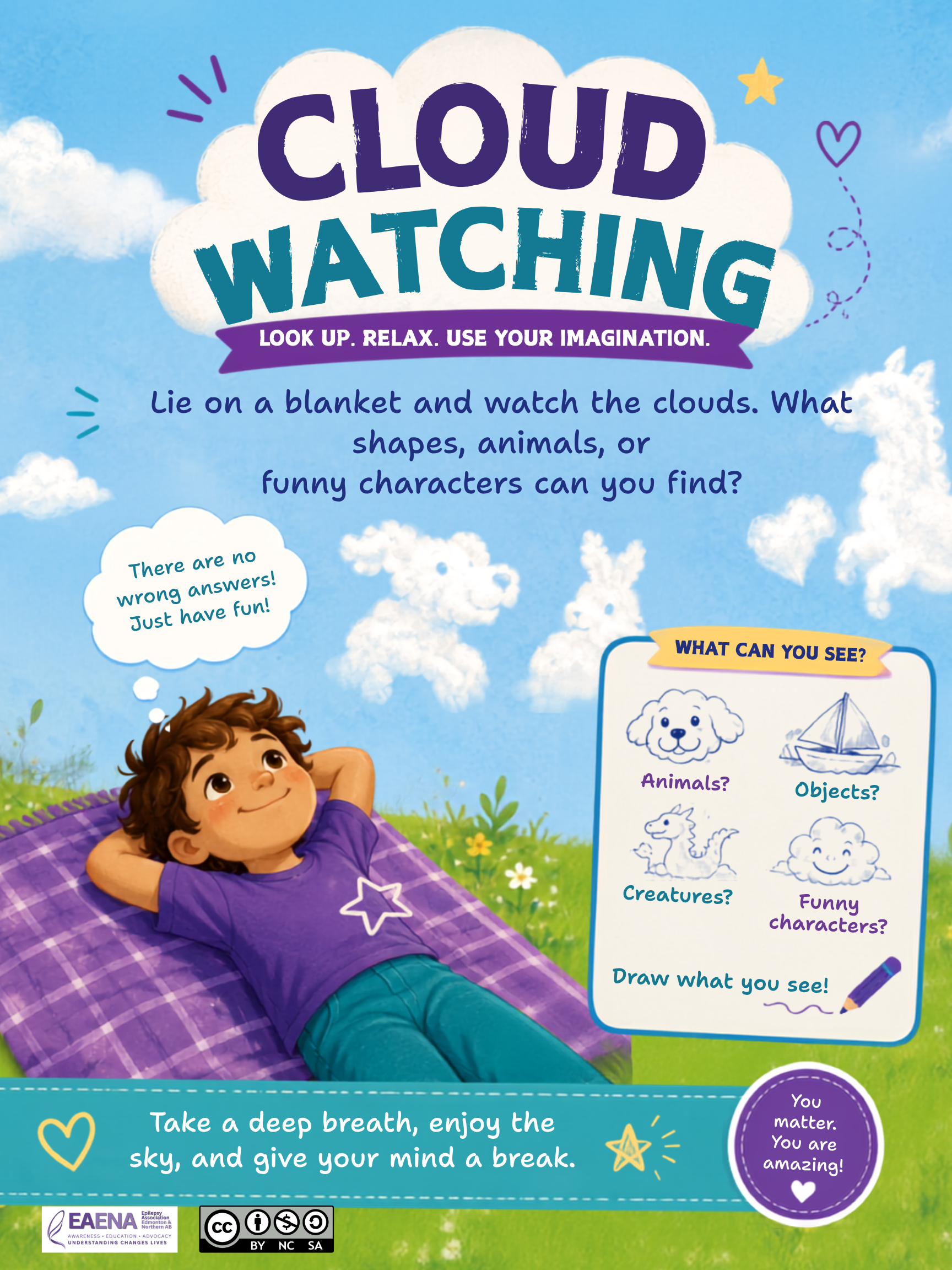
Cloud watching can be a simple, calming activity for children with epilepsy because it gives them a chance to slow down, focus on the present moment, and take a break from worries. It does not treat epilepsy or prevent seizures, but it can be a useful relaxation and coping activity.
☁️ How Cloud Watching Can Ease Anxiety
👀 1. Shifts attention away from worries
Instead of thinking about seizures, school, or other concerns, children can focus on finding shapes and patterns in the clouds. This gives their mind something gentle and interesting to concentrate on.
🌬️ 2. Encourages slower breathing
When children lie or sit comfortably and watch the sky, they may naturally begin breathing more slowly. You can encourage them to notice their breathing without making it feel like a formal exercise.
🧠 3. Brings them into the present moment
Cloud watching is a form of mindful observation. Children can notice:
What shapes they see
How the clouds move
The colour of the sky
How warm or cool the air feels
Sounds around them
This helps move attention from “What if I have a seizure?” toward “What do I notice right now?”
☁️ 4. Gives the brain a mental break
Living with epilepsy can sometimes mean thinking about medications, appointments, safety, or when the next seizure might happen. A quiet outdoor activity can provide a short break from those thoughts.
💭 5. Encourages imagination and positive thinking
Asking, “Does that cloud look like a dragon, dog, spaceship, or funny face?” turns the activity into something playful. Imagination can help create a more positive emotional experience.
❤️ 6. Creates a sense of calm and control
A child can choose where to sit, what cloud to watch, and what shapes to imagine. For children who sometimes feel that epilepsy makes things unpredictable, having a simple activity they can choose for themselves can feel empowering.
🌤️ Try a 5-Minute Cloud-Watching Calm
1 minute: Get comfortable and look at the sky.
1 minute: Find three different cloud shapes.
1 minute: Watch one cloud slowly move.
1 minute: Take a few comfortable, slow breaths.
1 minute: Name one thing you see, one thing you hear, and one thing you feel.
A helpful reminder for kids:
“I don’t have to make my worries disappear. I can give my brain a quiet five-minute break.”
For children with epilepsy, choose a safe, supervised location, particularly outdoors, and follow the child’s usual seizure-safety plan. Cloud watching should be presented as a calming and mindfulness activity—not as a treatment for seizures or anxiety disorders.
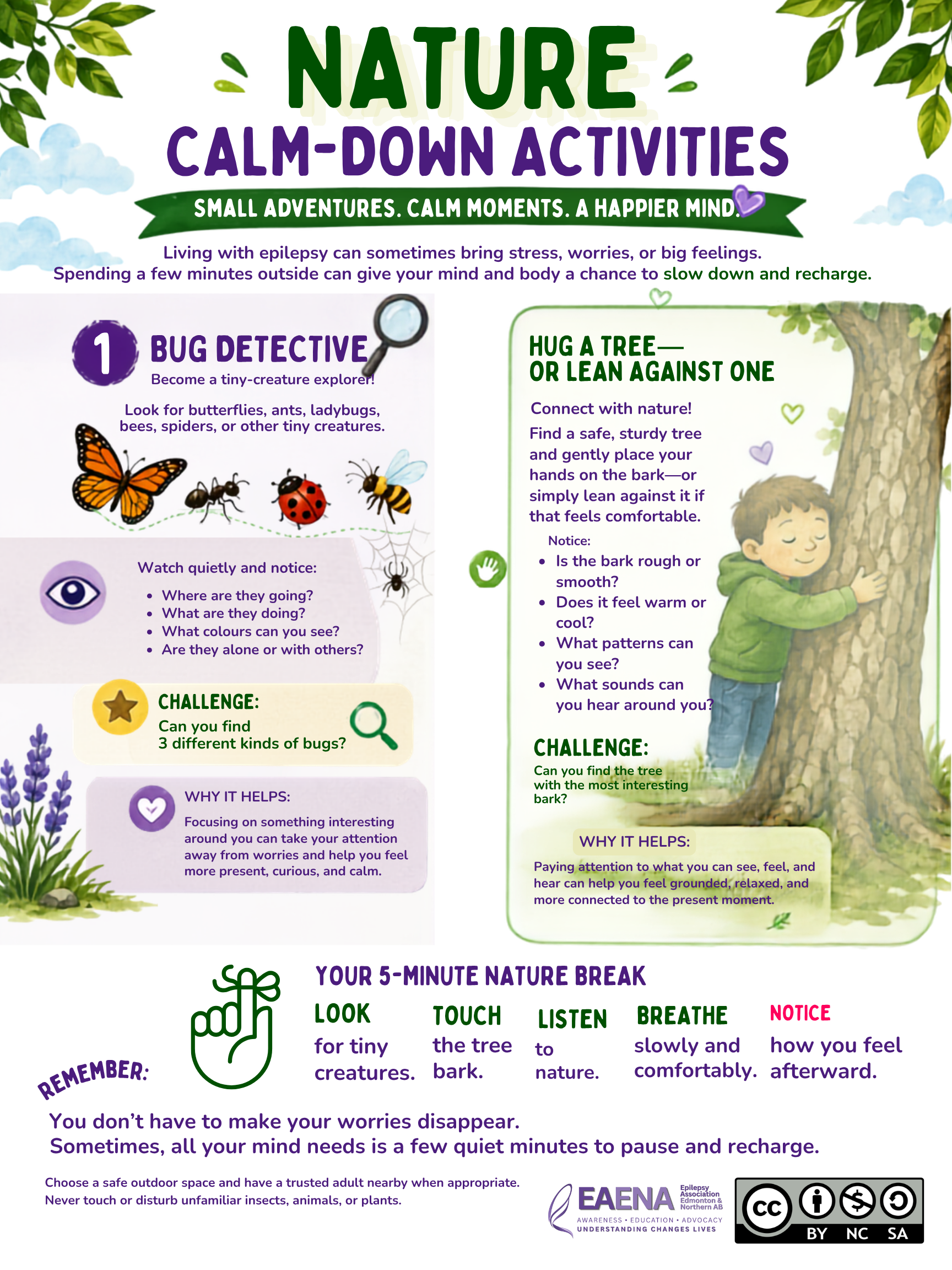
🌿 NATURE CALM-DOWN ACTIVITIES
Small adventures. Calm moments. A happier mind. 💚
Living with epilepsy can sometimes bring stress, worries, or big feelings. Spending a few minutes outside can give your mind and body a chance to slow down and recharge.
🦋 1. BUG DETECTIVE
Become a tiny-creature explorer! 🔎
Look for butterflies, ants, ladybugs, bees, spiders, or other tiny creatures.
👀 Watch quietly and notice:
- Where are they going?
- What are they doing?
- What colours can you see?
- Are they alone or with others?
🌟 Challenge:
Can you find 3 different kinds of bugs?
Why it helps: Focusing on something interesting around you can take your attention away from worries and help you feel more present, curious, and calm.
🌲 2. HUG A TREE — OR LEAN AGAINST ONE
Connect with nature! 🌳
Find a safe, sturdy tree and gently place your hands on the bark—or simply lean against it if that feels comfortable.
Notice:
- Is the bark rough or smooth?
- Does it feel warm or cool?
- What patterns can you see?
- What sounds can you hear around you?
Take a few slow, comfortable breaths as you explore the tree using your senses.
🌟 Challenge:
Can you find the tree with the most interesting bark?
Why it helps: Paying attention to what you can see, feel, and hear can help you feel grounded, relaxed, and more connected to the present moment.
💜 YOUR 5-MINUTE NATURE BREAK
🦋 Look for tiny creatures.
🌲 Touch the tree bark.
👂 Listen to nature.
🌬️ Breathe slowly and comfortably.
😊 Notice how you feel afterward.
Remember:
You don’t have to make your worries disappear.
Sometimes, all your mind needs is a few quiet minutes to pause and recharge. 💜
Choose a safe outdoor space and have a trusted adult nearby when appropriate. Never touch or disturb unfamiliar insects, animals, or plants.
Why these activities can help
- They encourage mindfulness. Watching a bug or feeling tree bark helps children focus on what they can see, hear, and feel right now instead of getting caught up in worries.
- They provide a calming sensory experience. Nature offers gentle sounds, textures, colours, and movement that can help children feel more grounded and relaxed.
- They create a sense of curiosity and enjoyment. Looking for insects or exploring trees turns attention toward discovery and play.
- They give children a simple coping tool. Short activities like these can help children learn that they can pause and take a moment for themselves when they are feeling overwhelmed.
- They encourage time outdoors and gentle movement. Spending time in a safe outdoor environment can support mood, relaxation, and overall wellbeing.
- They help build confidence. Completing a small challenge—such as finding three different bugs—can give children a sense of accomplishment and independence.
Important: These activities are not treatments for epilepsy or mental health conditions. They are simple wellbeing activities that may help children feel calmer and more connected to the present moment, alongside appropriate medical care and support.
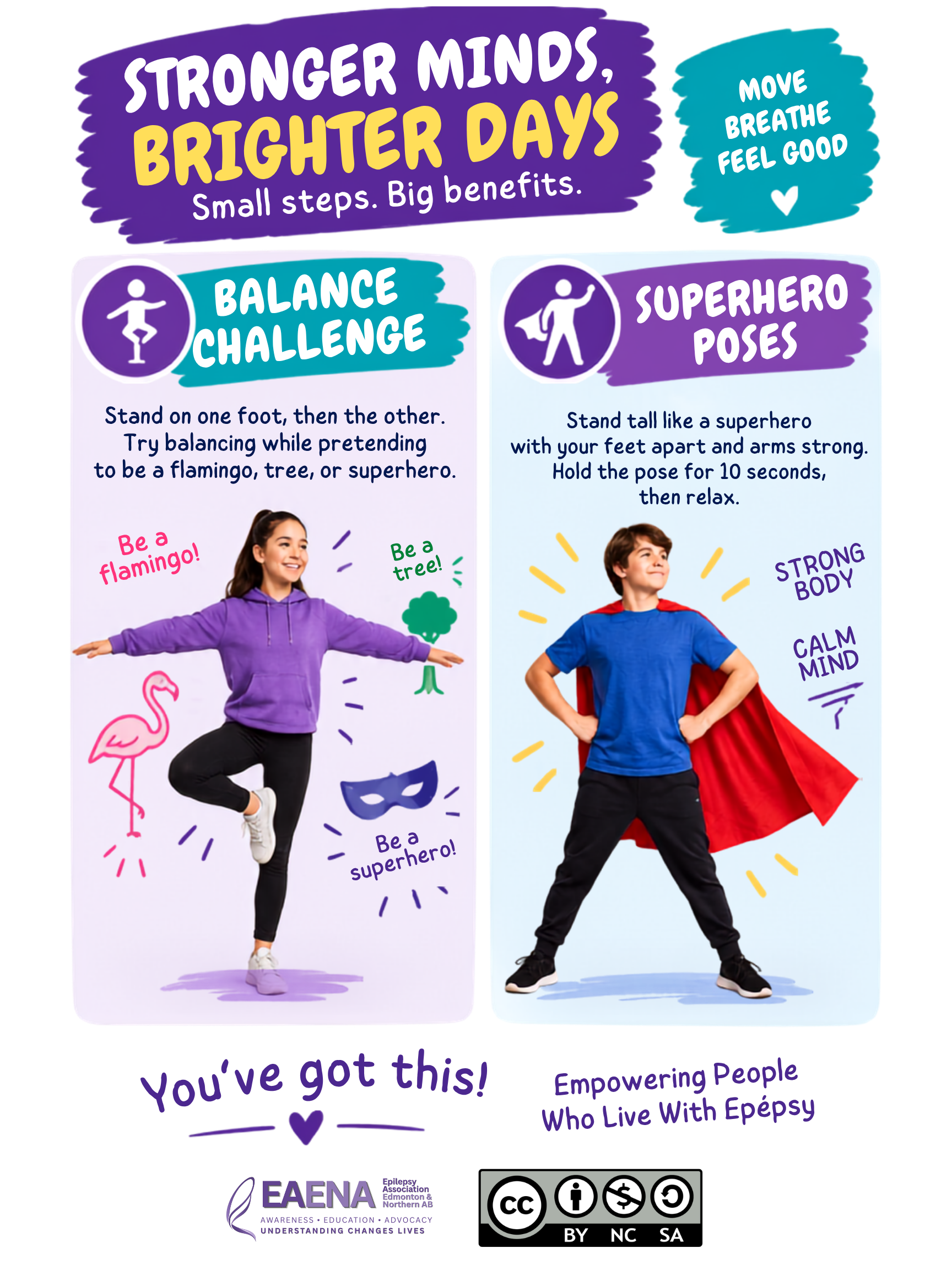
Both activities can be helpful because they give older kids a simple way to slow down, focus their attention, release physical tension, and feel more in control. For kids living with epilepsy, these skills can be especially valuable when worry about seizures, school, social situations, or uncertainty feels overwhelming.
💨 Blow-and-Move Game
Pretend you are blowing up a giant bubble. Take a slow breath in, then slowly breathe out while moving your arms outward.
How it can help:
- 🌬️ Encourages slow breathing: A longer, slower exhale can help the body shift toward a calmer state.
- 🧠 Calms a busy mind: Focusing on breathing and movement gives the brain something simple to concentrate on.
- 💪 Releases tension: Gentle arm movements can help loosen muscles that become tense when someone is worried or stressed.
- 🎈 Creates a sense of control: The child can use the activity whenever they notice themselves feeling overwhelmed.
- 😊 Makes calming down feel less like a “therapy exercise”: The playful bubble idea can make a coping strategy feel natural and age-appropriate.
🧘 Balance Challenge
Stand on one foot, then the other. Try balancing like a flamingo, tree, or superhero.
How it can help:
- 🎯 Builds focus: Balancing requires attention to the body and what is happening in the moment.
- 🧠 Encourages mindfulness: The child has to notice their feet, posture, breathing, and movements rather than focusing on worries.
- 💪 Builds confidence: Successfully holding a pose—even for a few seconds—can create a feeling of accomplishment.
- 🌳 Helps with grounding: Paying attention to physical sensations can help bring attention away from anxious thoughts.
- 🦸 Encourages self-expression: Using superhero or animal poses can make movement fun while reinforcing a sense of strength and capability.
A helpful message for older kids:
These activities won’t prevent or stop a seizure, but they can be tools for managing everyday stress and anxiety and helping you feel calmer and more connected to your body.
For a child with epilepsy, balance activities should be adapted for safety—for example, doing them near a wall or sturdy surface for support if there is a risk of falling.
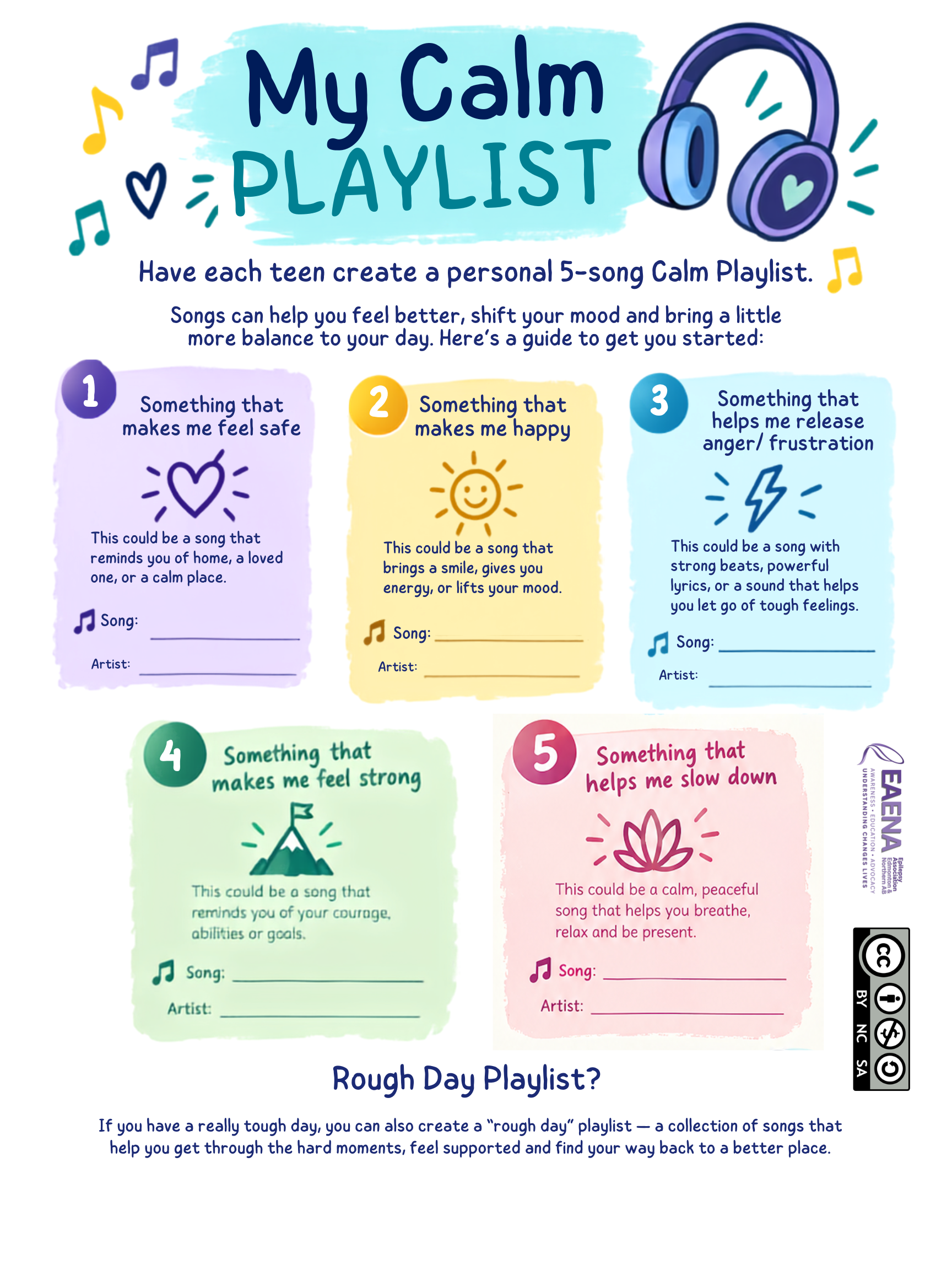 CLICK ON THE IMAGE TO SEE IT LARGER
Why “My Calm Playlist” is good for mental health
For kids and teens living with epilepsy, worry about when and where the next seizure might happen can create feelings of anxiety, loss of control, frustration, embarrassment, or isolation. “My Calm Playlist” gives them a simple, personal tool they can use to help manage those feelings.
🎵 It gives them a sense of control
Epilepsy can make young people feel that their bodies—and their plans—are sometimes outside their control. Choosing songs lets them make an intentional choice about how they want to feel or respond.
💜 It helps them identify emotions
The five categories encourage teens to think about different emotional needs: What makes me feel safe? What makes me happy? What helps when I’m angry? What makes me feel strong? This builds emotional awareness and vocabulary.
🧠 It provides a healthy coping strategy
Music can become one tool in a teen’s personal coping toolbox when they are stressed, overwhelmed, frustrated, or worried. Creating the playlist ahead of time means they don’t have to figure out what might help in the middle of a difficult moment.
🌿 It can support calming and relaxation
A “slow down” song can be paired with slow breathing, stretching, drawing, or simply taking a quiet break. This can create a familiar routine for managing everyday stress.
💪 It builds resilience and positive identity
The “strong” category encourages teens to connect with music that reminds them of their abilities and identity beyond epilepsy. They are more than their diagnosis.
🎧 It is private and teen-friendly
Some young people may not feel comfortable talking openly about anxiety or their fears about seizures. Making a playlist feels less like a mental-health exercise and more like something they would naturally do.
📱 The “Rough Day Playlist” makes the strategy portable
A teen can keep it on their phone and have it available at home, at school, while travelling, or before an activity that makes them nervous.
Most importantly
The activity doesn’t promise to prevent seizures or replace professional mental-health support. It gives teens another tool for managing the emotional challenges that can come with living with epilepsy.
A great message to put on the activity sheet would be:
“You can’t always control what happens—but you can build a playlist that helps you through it.”
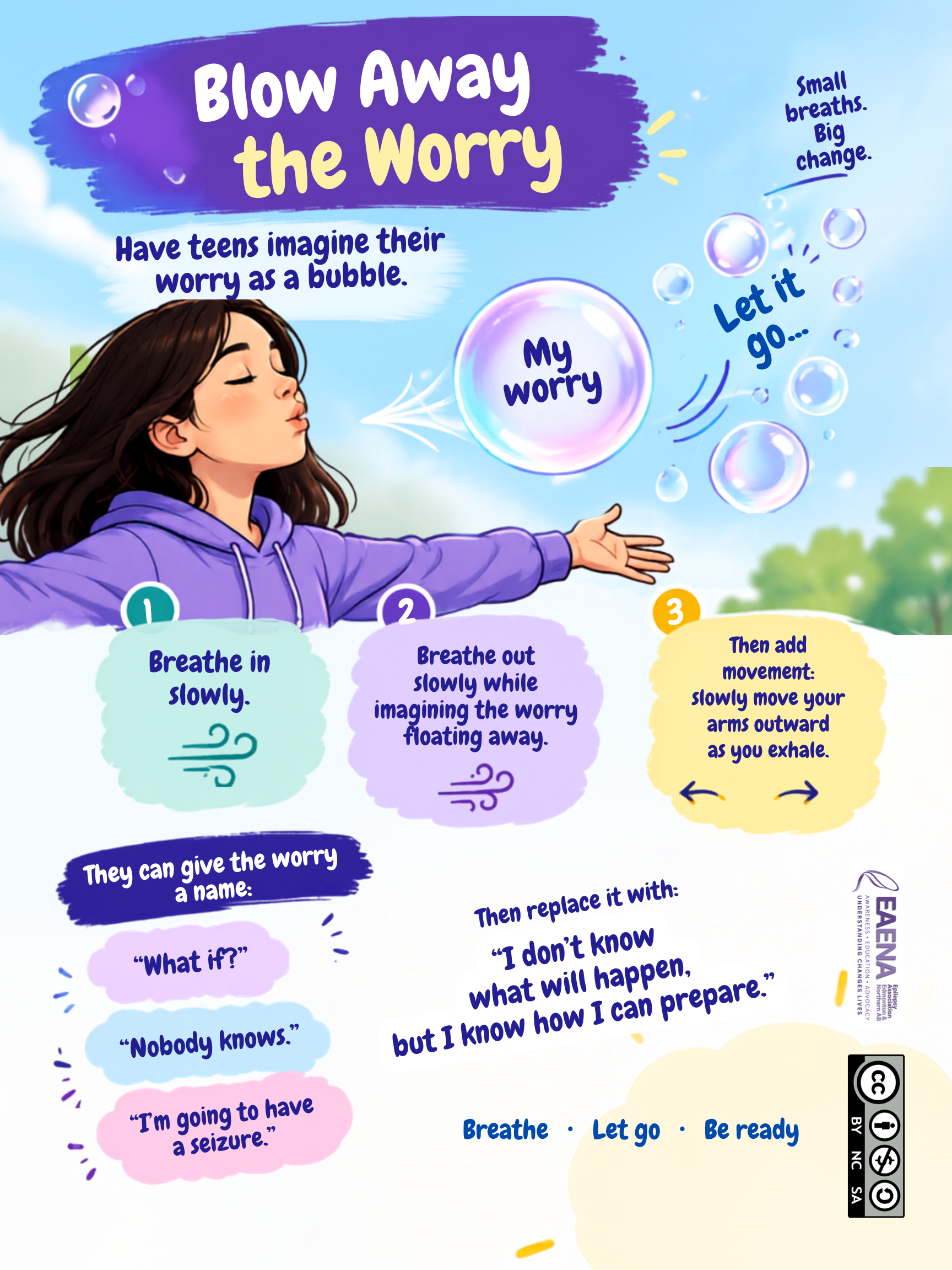
💜 Why this activity can help
1. It helps interrupt the worry cycle
Children with epilepsy may experience repeated “What if?” thoughts: What if I have a seizure at school? What if nobody knows what to do? Imagining the worry as a bubble gives the thought something they can picture and let go of rather than continuing to replay it.
2. Slow breathing can help the body settle
Slow, controlled breathing can encourage a calmer physical state when someone feels anxious or overwhelmed. Pairing the breath with movement makes the strategy concrete and easy for young people to practise.
3. It gives kids something they can control
Epilepsy can create feelings of uncertainty and loss of control. The activity shifts the focus from “I can’t control when a seizure happens” to “I can control how I respond to this worry.”
4. It validates their fears without reinforcing them
The activity doesn’t tell a child, “Don’t worry.” Instead, it acknowledges that worries such as “I’m going to have a seizure” are real thoughts they may experience. Then it helps them respond to those thoughts in a more balanced way.
5. It builds a coping skill they can use anywhere
The technique requires no equipment. A teen can use slow breathing and arm movements at home, in class, before going somewhere new, or whenever anxiety starts building.
6. It changes “What if?” into “What can I do?”
This is particularly important for epilepsy-related anxiety. The replacement statement:
“I don’t know what will happen, but I know how I can prepare.”
helps move the young person from fear and uncertainty → preparation and confidence.
7. It can strengthen a sense of self-efficacy
Each time a young person successfully uses a coping strategy, they practise the idea that “I have tools that can help me when I feel worried.” Over time, that can contribute to greater confidence in managing difficult emotions.
🌱 The bigger mental-health message
The goal isn’t to make epilepsy-related worry disappear. It’s to help young people recognize the worry, calm their body, and choose what to do next.
For children and teens living with epilepsy, that can be an important step toward feeling less overwhelmed by uncertainty and more capable of managing it.
This is a coping and emotional-regulation activity, not a treatment for epilepsy or a substitute for professional mental-health care.
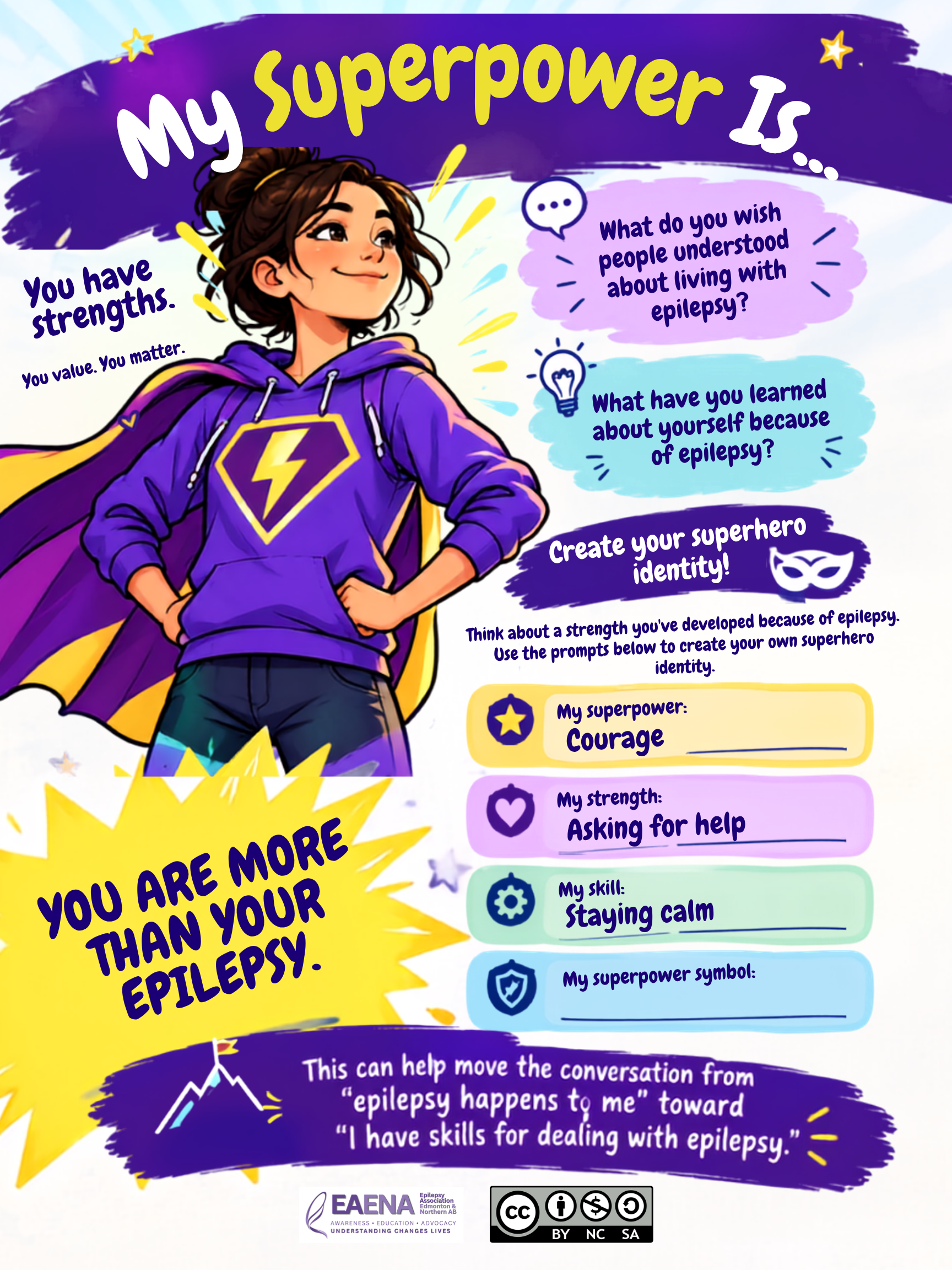
💜 Why “My Superpower Is…” supports mental health for kids with epilepsy
This activity helps shift the focus from what epilepsy takes away to the strengths a young person has developed while living with it.
1. It builds self-esteem
Epilepsy can sometimes make children and teens feel different, limited, or less confident. Identifying qualities such as courage, patience, resilience, or asking for help reminds them that they have strengths that matter.
2. It changes the story they tell about themselves
Instead of seeing themselves primarily as “someone who has seizures,” they can begin to see themselves as a person who has learned valuable skills for handling difficult situations.
3. It gives them a sense of control
Seizures can feel unpredictable. Acknowledging skills such as staying calm, preparing for a seizure, communicating needs, or asking for support reinforces the idea that although they cannot always control epilepsy, they can develop ways to respond to it.
4. It encourages healthy self-expression
The questions—“What do you wish people understood?” and “What have you learned about yourself?”—give teens permission to talk about experiences that may otherwise be difficult to explain.
5. It challenges stigma
Creating a superhero identity can help teens recognize that epilepsy does not define their entire identity. They can communicate to others: “There is much more to me than my epilepsy.”
6. It recognizes asking for help as a strength
This is especially important. Young people may worry that needing support makes them weak. The activity reframes asking for help, speaking up, and using a support network as skills and strengths.
7. It builds resilience
The activity encourages young people to identify what they have learned through challenging experiences. That can help them recognize their ability to adapt, cope, and keep moving forward.
🌟 The key mental-health message
The activity moves the conversation from:
“Epilepsy happens to me.”
⬇️
“I have strengths and skills that help me live with epilepsy.”
It doesn’t suggest that epilepsy is a superpower or that young people should be positive about something difficult. Instead, it helps them recognize their own courage, skills, identity, and resilience alongside epilepsy.
PLAN FOR THE PLACE NOT THE SEIZURE
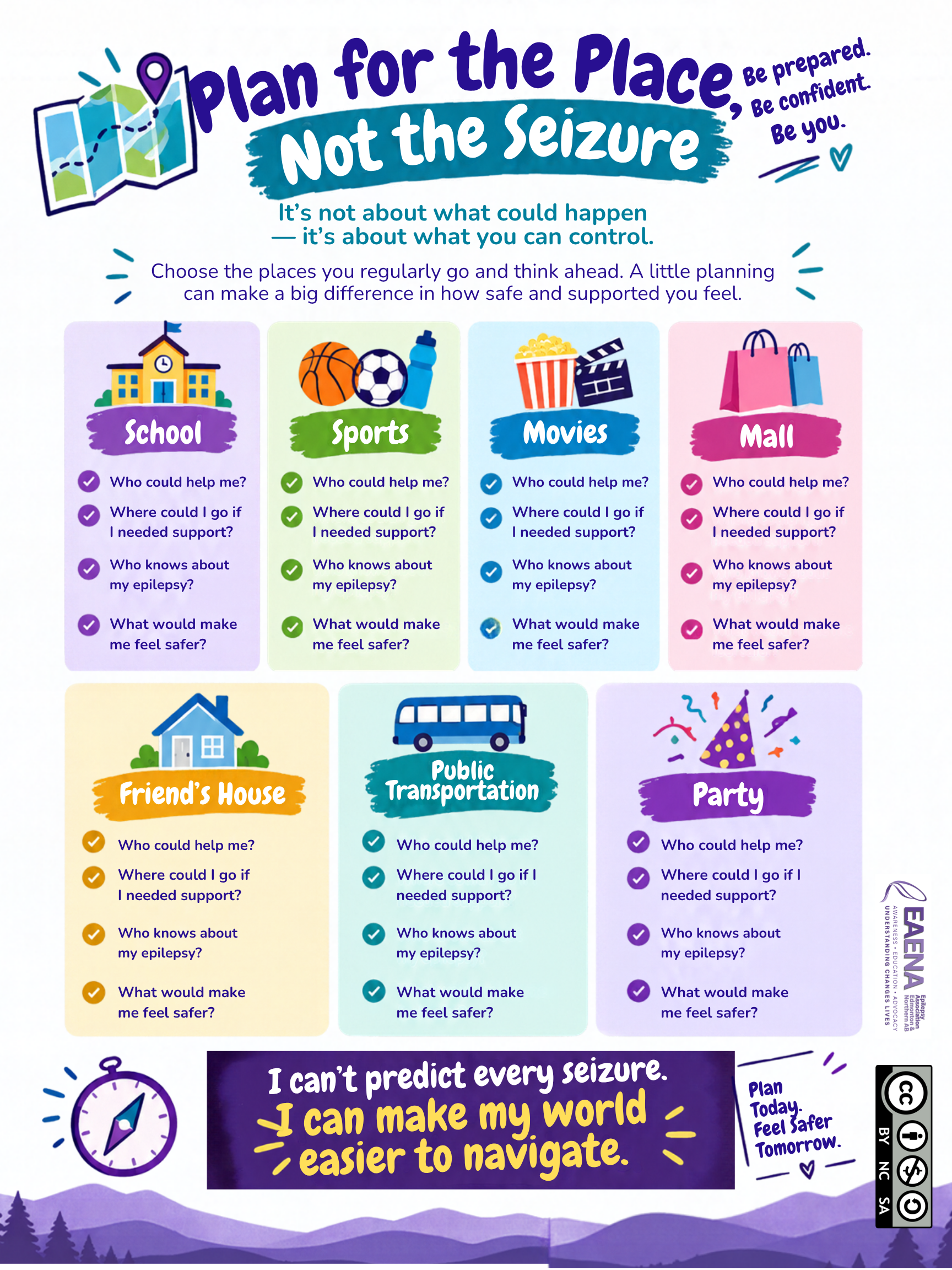 CLICK ON THE IMAGE TO SEE IT LARGER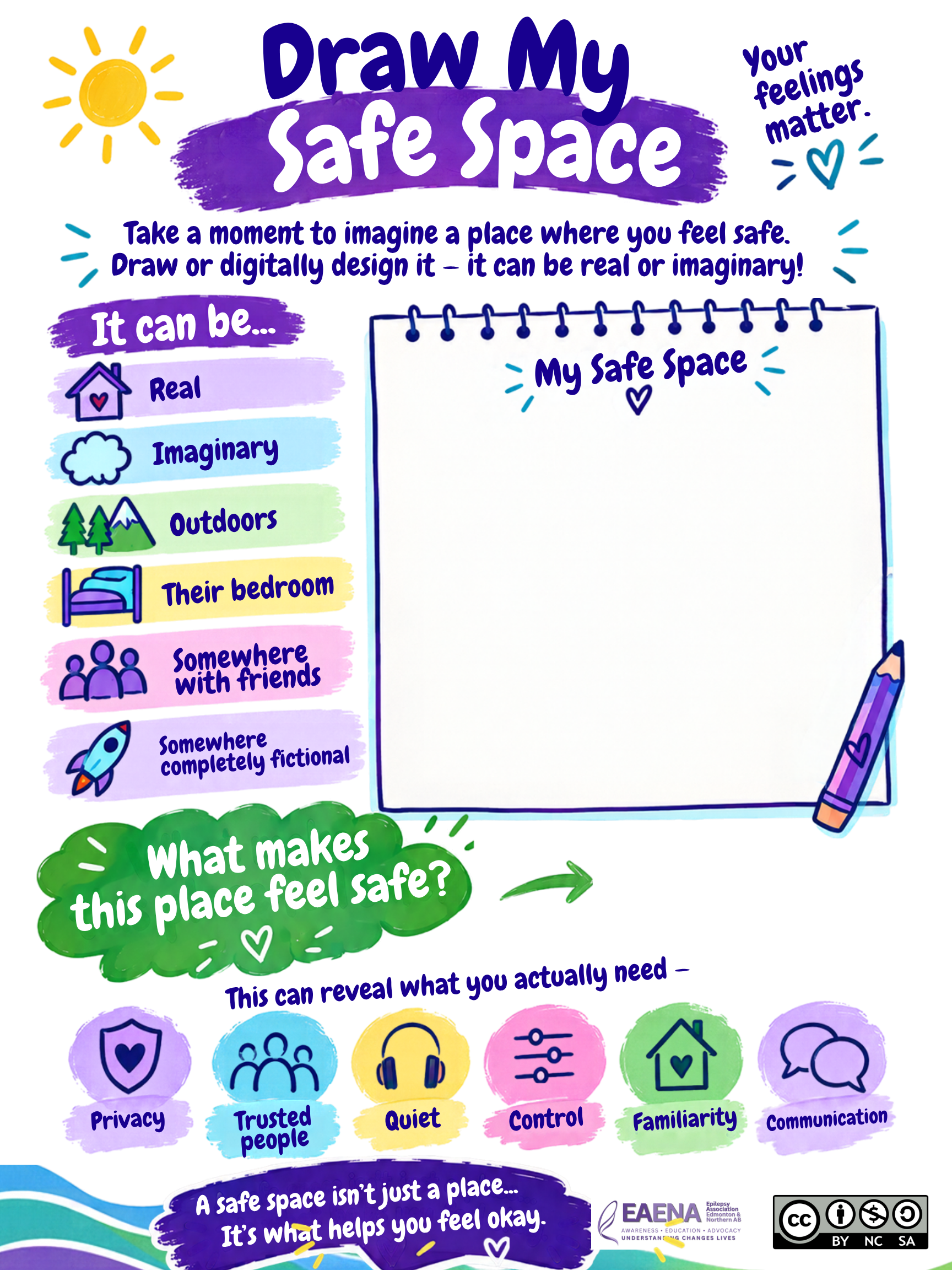
CALM BODY
 CLICK ON THE IMAGE TO SEE IT LARGER
CLICK HERE FOR THE PDF TO PRINT OUT
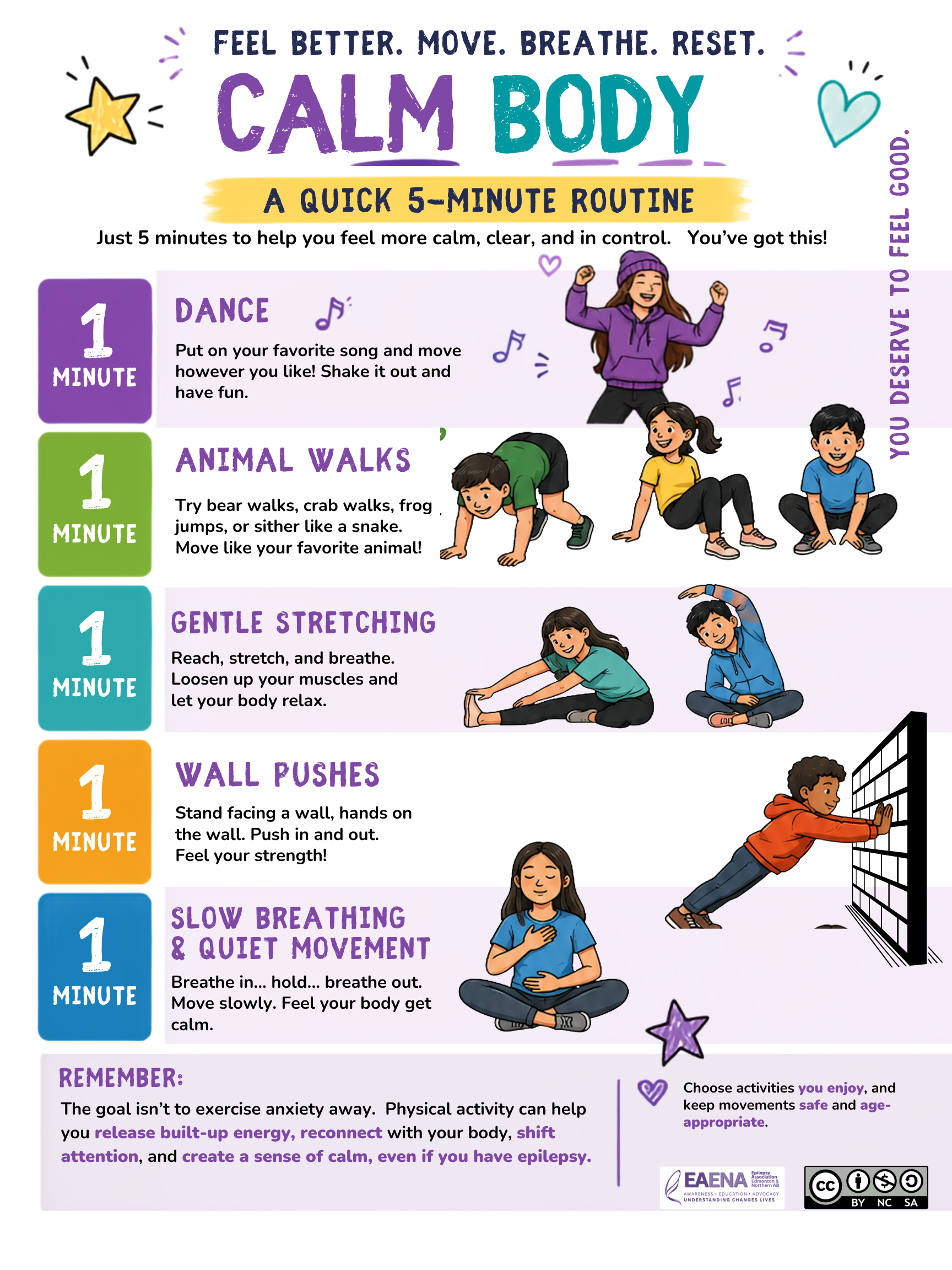
Physical activity can help children release built-up energy, reconnect with their bodies, shift attention, and create a sense of calm.
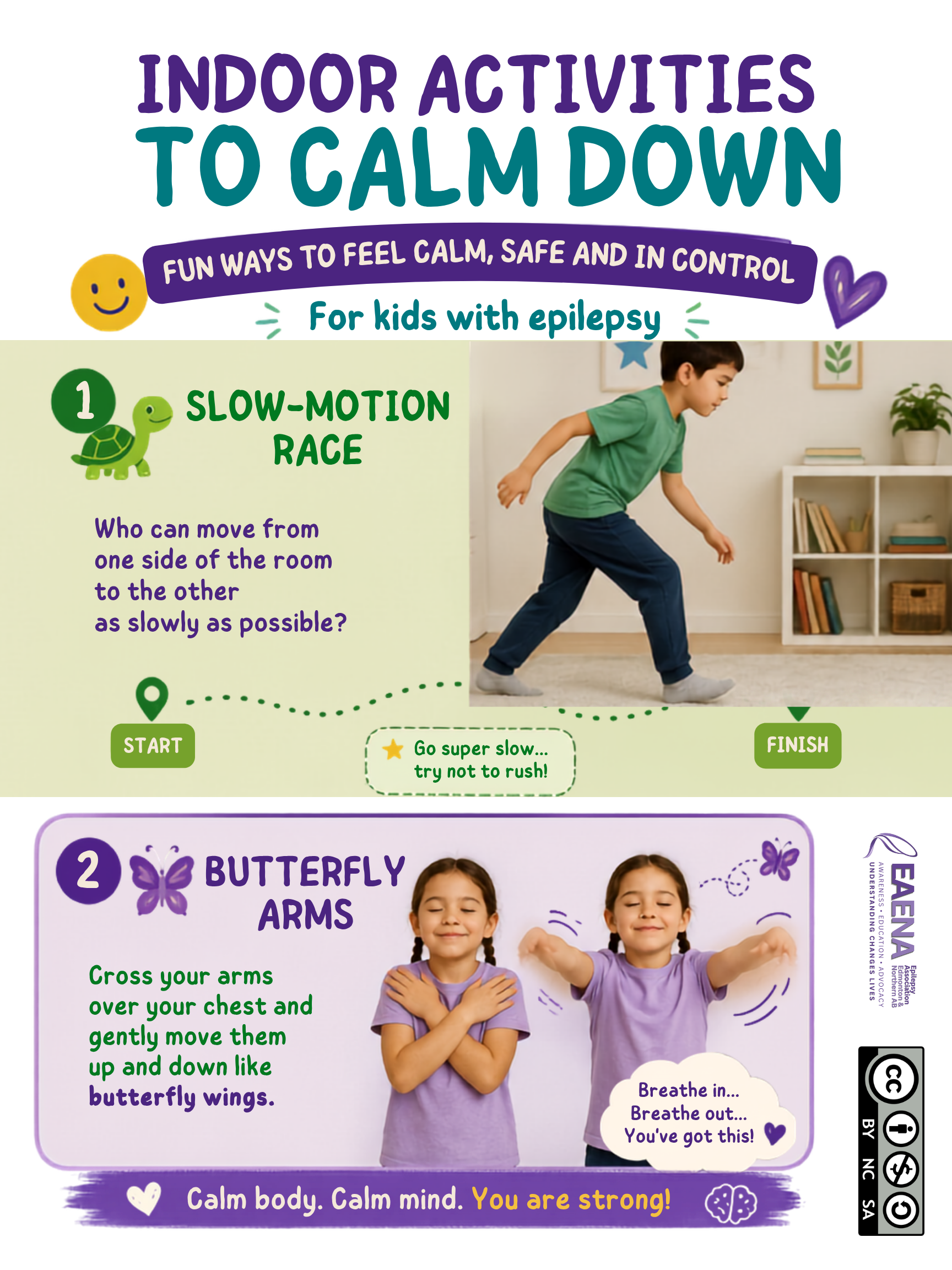
These activities can help children with epilepsy shift their attention away from worries about seizures, feeling different, or what other people might think. They are simple, playful ways to help the body slow down when the mind feels busy.
🐢 Slow-Motion Race
Who can move from one side of the room to the other as slowly as possible?
Moving very slowly makes the child pay attention to each movement—their feet, balance, breathing, and what is happening around them. Instead of focusing on thoughts like “What if I have another seizure?” or “Why am I different?”, their brain has a fun challenge to concentrate on.
It can also:
- 🧠 Interrupt racing thoughts by giving the brain a simple task.
- 🌿 Slow the body down when a child feels tense or overwhelmed.
- 😊 Create a sense of control—the child decides how slowly to move.
- 🤝 Make epilepsy feel less central by turning the moment into a shared game rather than a discussion about seizures.
- ⭐ Build confidence because there is no “wrong” way to do the race—the goal is simply to try.
A helpful message for kids:
“For this race, you don’t have to be fast. Your only job is to notice your body and move at your own pace.”
🦋 Butterfly Arms
Cross your arms over your chest and gently move them up and down like butterfly wings.
This gentle, repetitive movement gives children something physical and predictable to focus on. The sensation of their arms moving can help bring their attention back to the present moment when their thoughts are stuck on seizures, embarrassment, or feeling different.
It can:
- 🧠 Give the brain something gentle to concentrate on.
- 🌬️ Encourage slower, calmer breathing when paired with comfortable breathing.
- 💜 Provide a comforting, reassuring movement without requiring children to talk about their feelings.
- 🌸 Help shift attention from “Why am I different?” to “What am I feeling in my body right now?”
- 🦋 Remind children that they are more than their epilepsy—they can play, move, laugh, and participate just like other kids.
A helpful message for kids:
“Let your arms be butterfly wings. Feel them move, notice your breathing, and give your brain a little break from seizure thoughts.”
💜 The bigger idea
Neither activity is meant to stop thoughts about seizures completely. The goal is to teach children that when an upsetting thought appears, they can pause, move, focus on something in the present, and give their minds a break.
For children with epilepsy, this can be especially valuable because worries about having another seizure or being treated differently can sometimes become a big part of their day. These activities offer a playful, non-medical way to practise coping and regaining a sense of control.
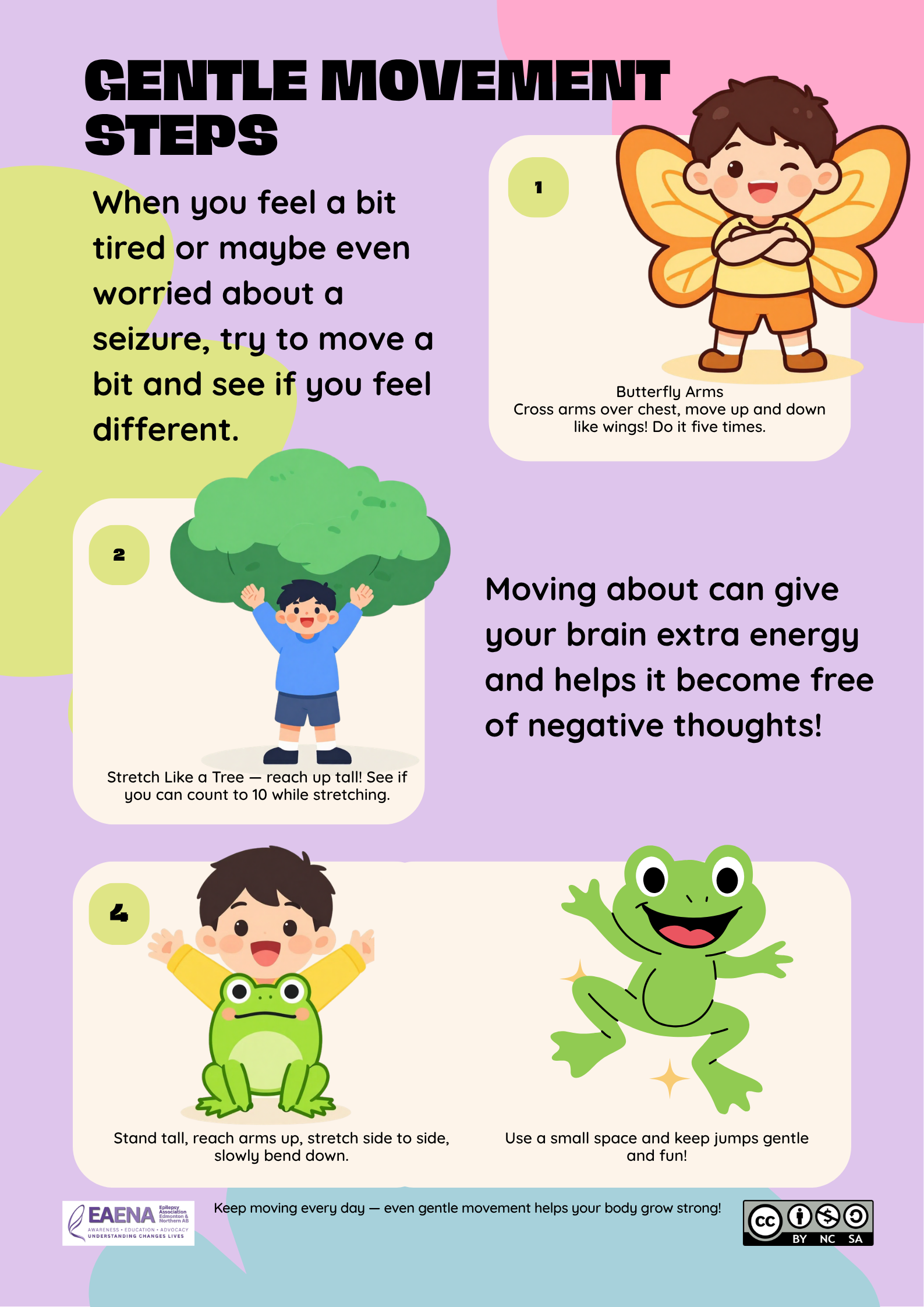
GENTLE MOVEMENT BREAKS
 CLICK ON IMAGE TO SEE IT LARGER
CLICK HERE TO OPEN AND DOWNLOAD THE PDF
Sometimes our brain can get stuck in negative loops. A simple five-ten minute break, with some nice movements you can do anywhere indoor or outside, may help you feel better in minutes. Try these movements alone or with a friend. Remember to check in how you feel before and after the activities, and notice is changes happen for the better.
BLOW A BUBBLE AND BALANCE CHALLENGE
 CLICK ON IMAGE TO SEE IT LARGER
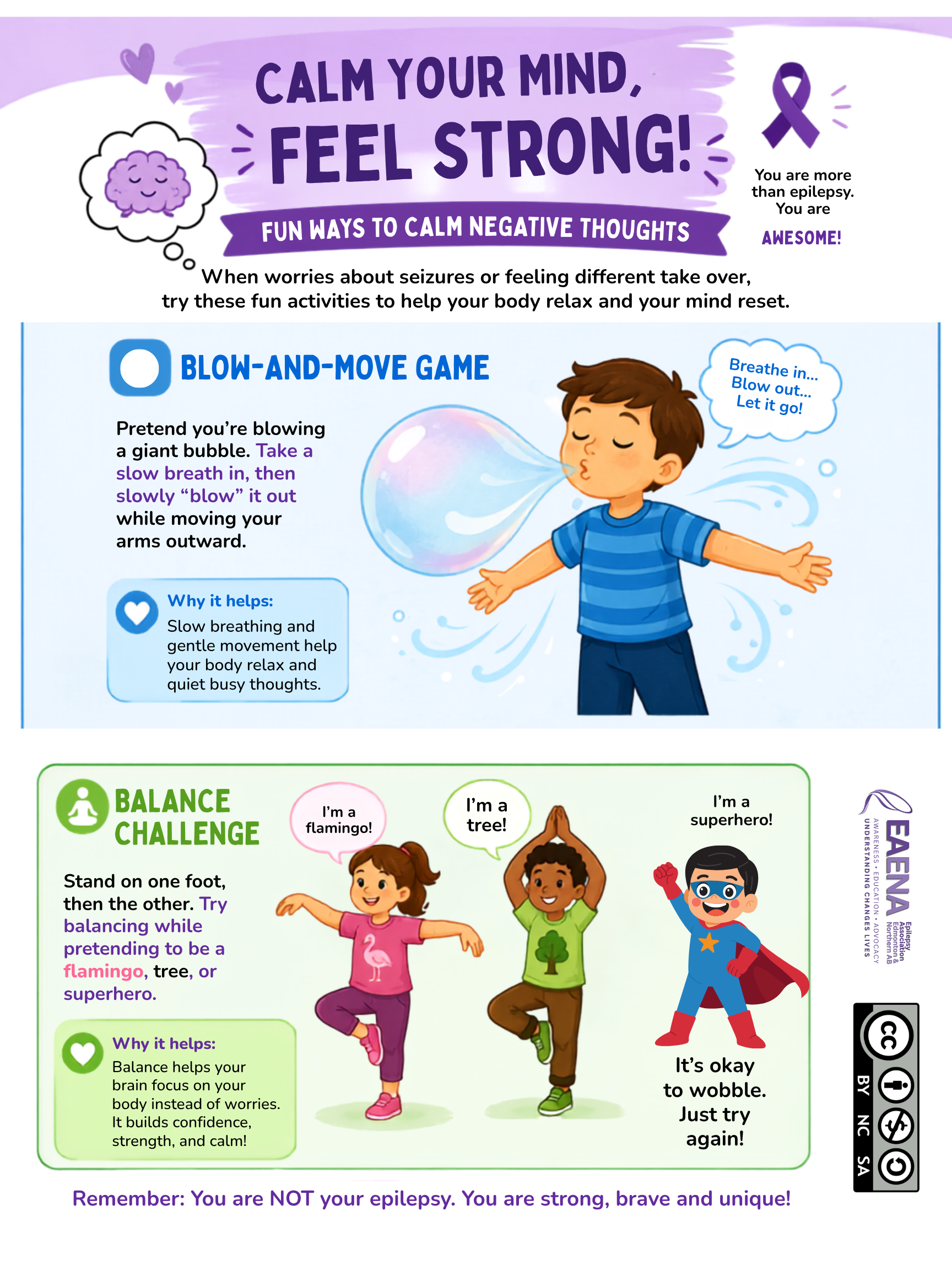
These activities can help a child with epilepsy slow down, release tension, and shift attention away from upsetting thoughts or feelings. They are not a treatment for epilepsy, but they can be useful calming activities when practiced safely.
💨 Blow-and-Move Game
Pretend you’re blowing a giant bubble. Take a slow breath in, then slowly “blow” it out while moving your arms outward.
Why it can help:
- 🌬️ Encourages slow breathing: A long, gentle exhale can help the body move toward a more relaxed state.
- 🧠 Gives the brain something positive to focus on: Imagining a giant bubble and coordinating the arm movement can interrupt a cycle of worrying or negative thoughts.
- 💪 Releases physical tension: Slow arm movements can help the child relax their shoulders, arms, and upper body.
- 😊 Makes calming feel like play: Turning breathing into a game can make it easier for children to use the technique without feeling like they are being told to “calm down.”
Tip: The child should breathe comfortably—never hold their breath or blow forcefully.
🧘 Balance Challenge
Stand on one foot, then the other. Try balancing while pretending to be a flamingo, tree, or superhero.
Why it can help:
- 🎯 Builds concentration: The child needs to pay attention to their body and balance, which can shift attention away from stressful thoughts.
- 🧍 Creates body awareness: Feeling where their feet, legs, and body are positioned can help bring their attention back to the present moment.
- 🌳 Encourages imaginative play: Pretending to be a tree, flamingo, or superhero can make the activity fun rather than stressful.
- 💪 Provides a sense of achievement: Successfully holding a position—even briefly—can give a child a feeling of control and confidence.
Important safety note for children with epilepsy: Balance activities should be done in a safe, uncluttered area and with an adult nearby, especially if the child has seizures that can affect awareness or balance. The child should stop if they feel dizzy, unwell, or unusual. For some children, a seated or supported balance activity may be a safer alternative.
Together, these activities teach an important message: “When my thoughts or feelings feel too big, I can pause, breathe, move, and bring my attention back to what is happening right now.”
OBSTACLE COURSE AND TARGET TOSS
CLICK ON IMAGE TO SEE IT LARGER
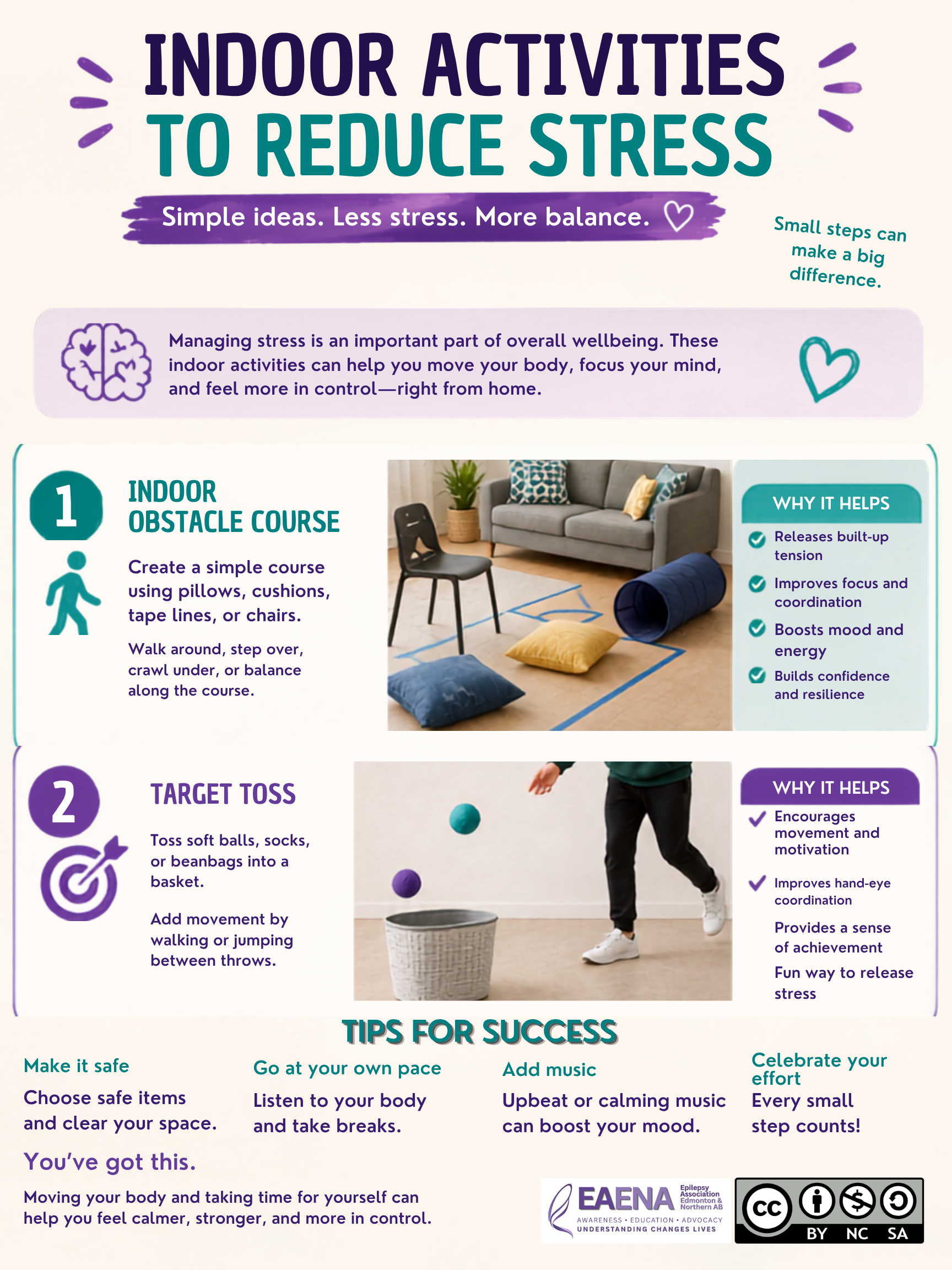
Indoor Obstacle Course 🚶
A simple obstacle course can help release built-up energy and tension while giving teens something active to focus on. Moving through the course may also encourage concentration, coordination, problem-solving, and a sense of accomplishment. Completing small challenges can help build confidence and provide a healthy break from stressful thoughts.
Target Toss 🎯
Target toss combines gentle movement with focus and coordination. Concentrating on the target can help shift attention away from worries and bring the mind into the present moment. It can also be a fun way to release tension, enjoy a sense of achievement, and boost mood.
Overall wellbeing benefits 💚
Both activities can:
- Encourage a healthy break from stress or worries
- Help focus attention on the present moment
- Provide an enjoyable outlet for energy and emotions
- Build confidence through small achievements
- Support mood and a sense of control
- Create opportunities for fun and positive movement
Important: Activities should always be adapted to the individual’s abilities and epilepsy safety needs. Choose a clear, safe space, avoid activities that may pose a risk during a seizure, and follow any personal safety guidance from a healthcare professional.
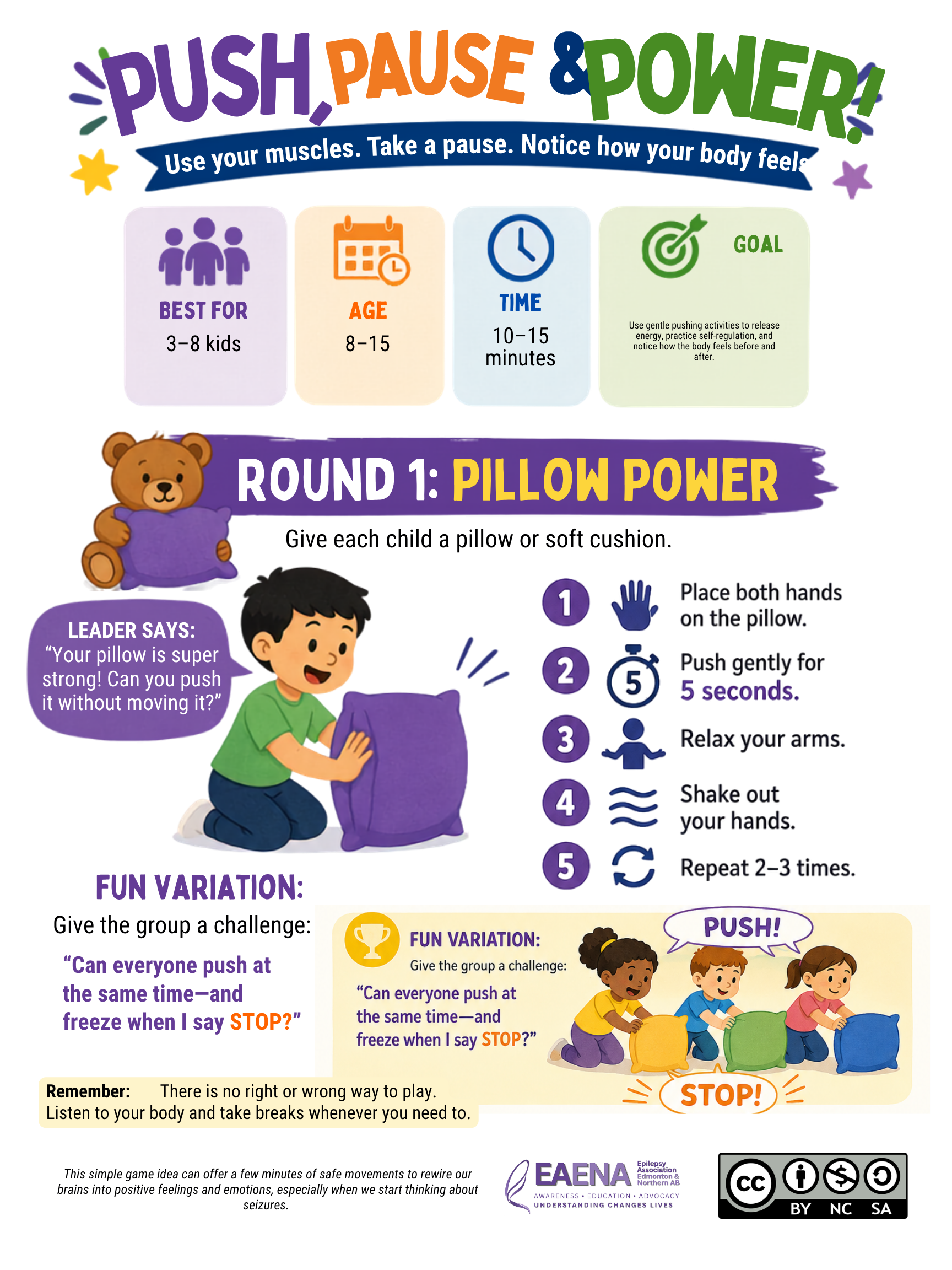 CLICK ON IMAGE TO SEE IT LARGER
“Push, Pause & Power!” can be a useful calming and self-regulation activity for children and teens with epilepsy because it combines gentle physical effort, body awareness, and a clear stop-and-pause routine.
🌿 Why “Pillow Power” Can Help Kids Feel Calm
💪 1. Releases built-up energy
Gentle pushing gives kids a safe way to use some of the physical energy that can come with stress, frustration, or restlessness.
🧠 2. Brings attention back to the body
Feeling their hands, arms, and muscles working can help children focus on what is happening right now, rather than worrying about what might happen next.
⏸️ 3. Teaches the “pause” skill
The push → stop → relax pattern gives kids a simple strategy they can use when they notice they are becoming overwhelmed.
🌬️ 4. Creates a natural transition to relaxation
After pushing, shaking out the hands and relaxing the arms helps children notice the difference between a tense body and a relaxed body.
🎯 5. Builds self-awareness
The leader can ask:
“How does your body feel before you push? How does it feel afterward?”
This encourages children to recognize their own signs of tension and calm.
🧩 6. Gives kids something they can control
Living with epilepsy can sometimes involve uncertainty. A simple activity where children choose how gently to push, when to relax, and how their body feels afterward can reinforce a sense of control and confidence.
👫 7. Makes calming practice fun and social
Doing the activity together—including the “freeze when I say STOP!” challenge—turns self-regulation into a game rather than something that feels like therapy or a lesson.
⭐ 8. Practices following a simple sequence
Remembering PUSH → STOP → RELAX → NOTICE helps children practice stopping and resetting their bodies when they need a break.
💜 Important epilepsy-friendly reminder
The activity should stay gentle and comfortable. The goal is not to push as hard as possible or become exhausted. Children should be able to stop immediately if they feel uncomfortable, dizzy, tired, or unwell. It is also helpful to avoid framing the activity as preventing seizures; instead, present it as a calming and self-regulation strategy.
🌟 A simple message for the poster
PUSH → PAUSE → RELAX → NOTICE
“Use your muscles. Stop. Let go. Notice how your body feels.”
This makes the activity particularly appropriate for your 8–15-year-old mental-wellbeing resources, because it teaches a concrete skill kids can remember and use outside the game.
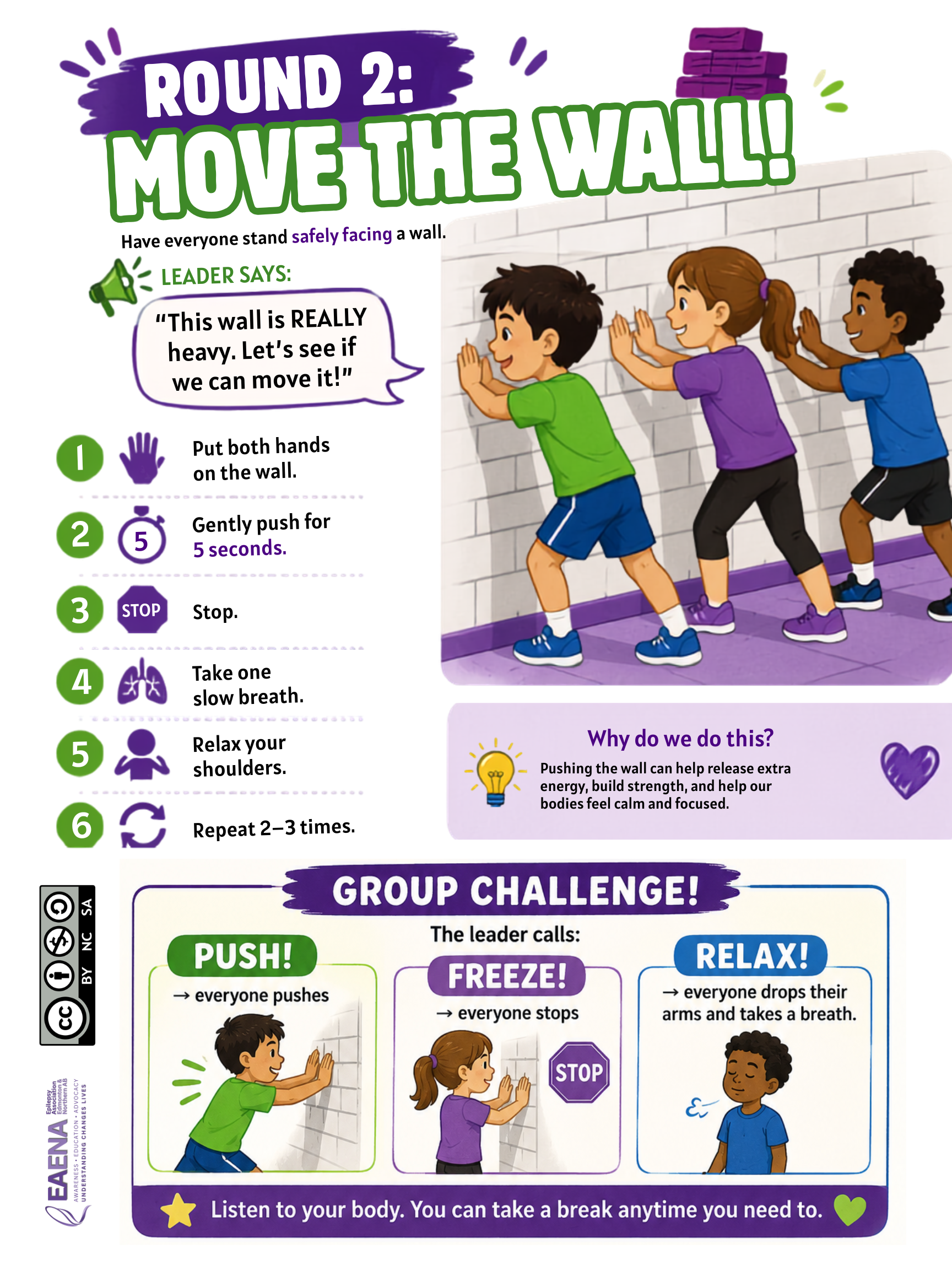 CLICK ON THE IMAGE TO SEE IT LARGER
💪 1. Helps release physical tension
Gentle pushing engages the arms, shoulders, and core. This can give kids a positive physical outlet when they feel restless, frustrated, or tense.
🧠 2. Helps shift attention away from worries
Focusing on the wall, their hands, and the pushing action gives their brain something concrete to concentrate on.
⏸️ 3. Practices stopping and resetting
The “PUSH → FREEZE → RELAX” sequence teaches children that they can pause an activity and help their body settle.
🌬️ 4. Connects movement with slow breathing
Taking one slow breath after pushing introduces a simple calming technique that children can use when they feel stressed or overwhelmed.
🙌 5. Teaches children to notice muscle tension
When they push, their muscles become active. When they relax their shoulders and arms, they can feel the difference between tension and relaxation.
🎯 6. Builds self-regulation skills
Following the leader’s commands—especially “FREEZE!”—requires children to control their movements and attention. With practice, this can strengthen their ability to pause before reacting.
👫 7. Makes calming skills fun
Because everyone participates together, it feels like a game rather than a relaxation exercise. The group challenge can also encourage laughter and connection.
⭐ 8. Gives kids a sense of accomplishment
They may not be able to control when a seizure happens, but they can practice skills that help them manage everyday feelings of stress, tension, and overwhelm.
💜 A simple message for kids
“Push out the tension. Freeze. Take a breath. Let your body relax.”
Important: Keep the pushing gentle—this is not a strength competition. Children should stop if they feel pain, dizziness, unusual sensations, or uncomfortable fatigue. The activity is intended to support calm and self-regulation, not to prevent seizures.
⭐ Round 3: Which One Feels Different?
After each activity, ask:
“What changed in your body?”
Kids can choose:
🟢 Calm
🟡 Energized
🔵 Relaxed
🟣 Strong
⚪ The same
There is no right or wrong answer.
🏆 Team Challenge: “Beat the Leader”
The leader performs a sequence and the kids copy:
Pillow Push → Relax → Wall Push → Relax → Big Stretch → Slow Breath
Then let the kids take turns being the leader.
💜 Important for kids with epilepsy
Keep the game gentle and optional. Avoid turning it into a competition about who can push hardest or hold the longest. Children should be able to stop, sit down, or take a break whenever they need to. Use soft pillows/cushions and make sure the space is clear of hazards.
MANDALA COLOURING PAGES CLICK ON IMAGE TO SEE IT LARGER
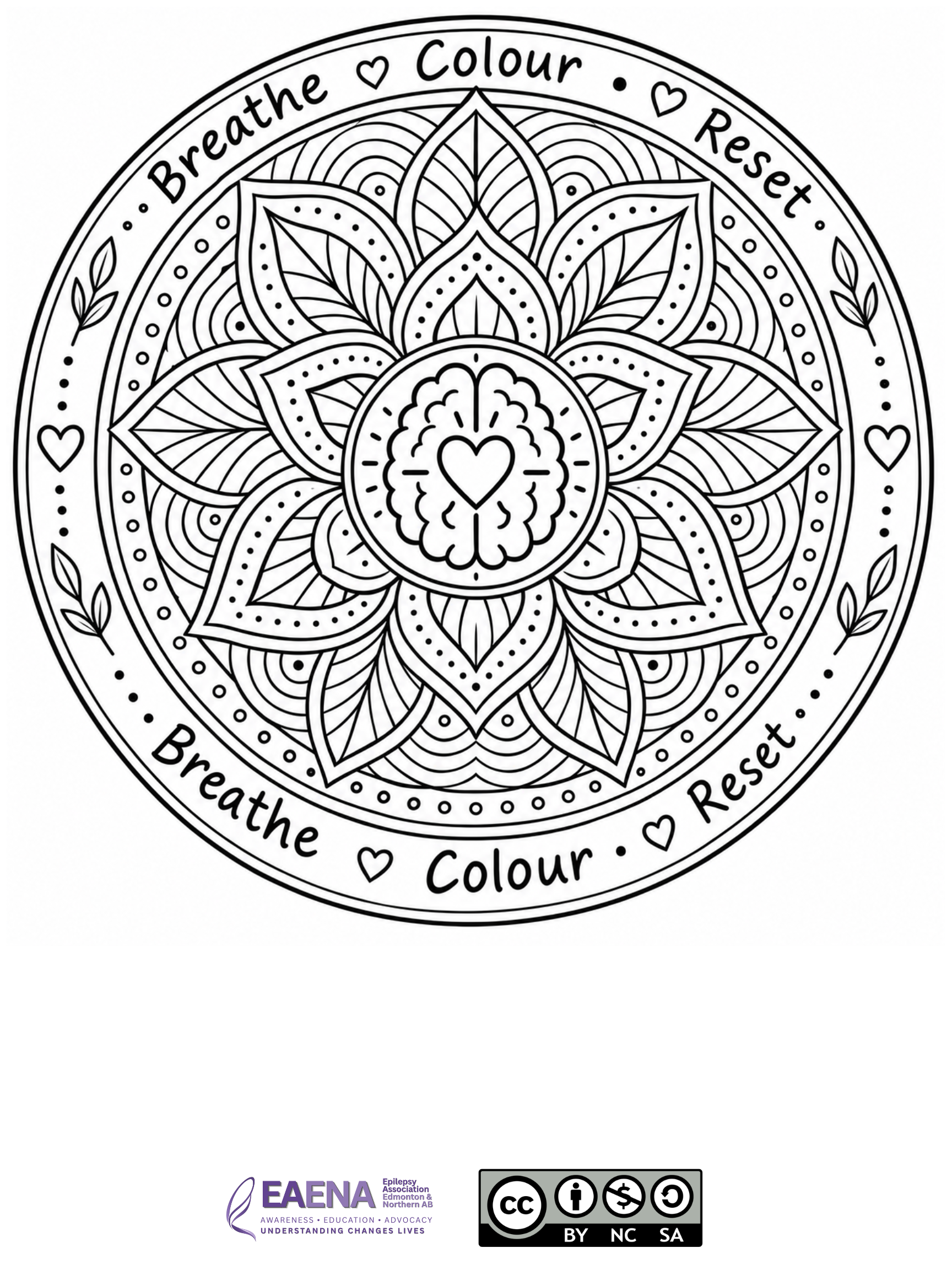 CLICK ON IMAGE TO SEE IT LARGER
CLICK HERE FOR TWO-PAGE DOWNLOADABLE PDF
A colouring page can help with relaxation.
 CLICK ON IMAGE TO SEE IT LARGER
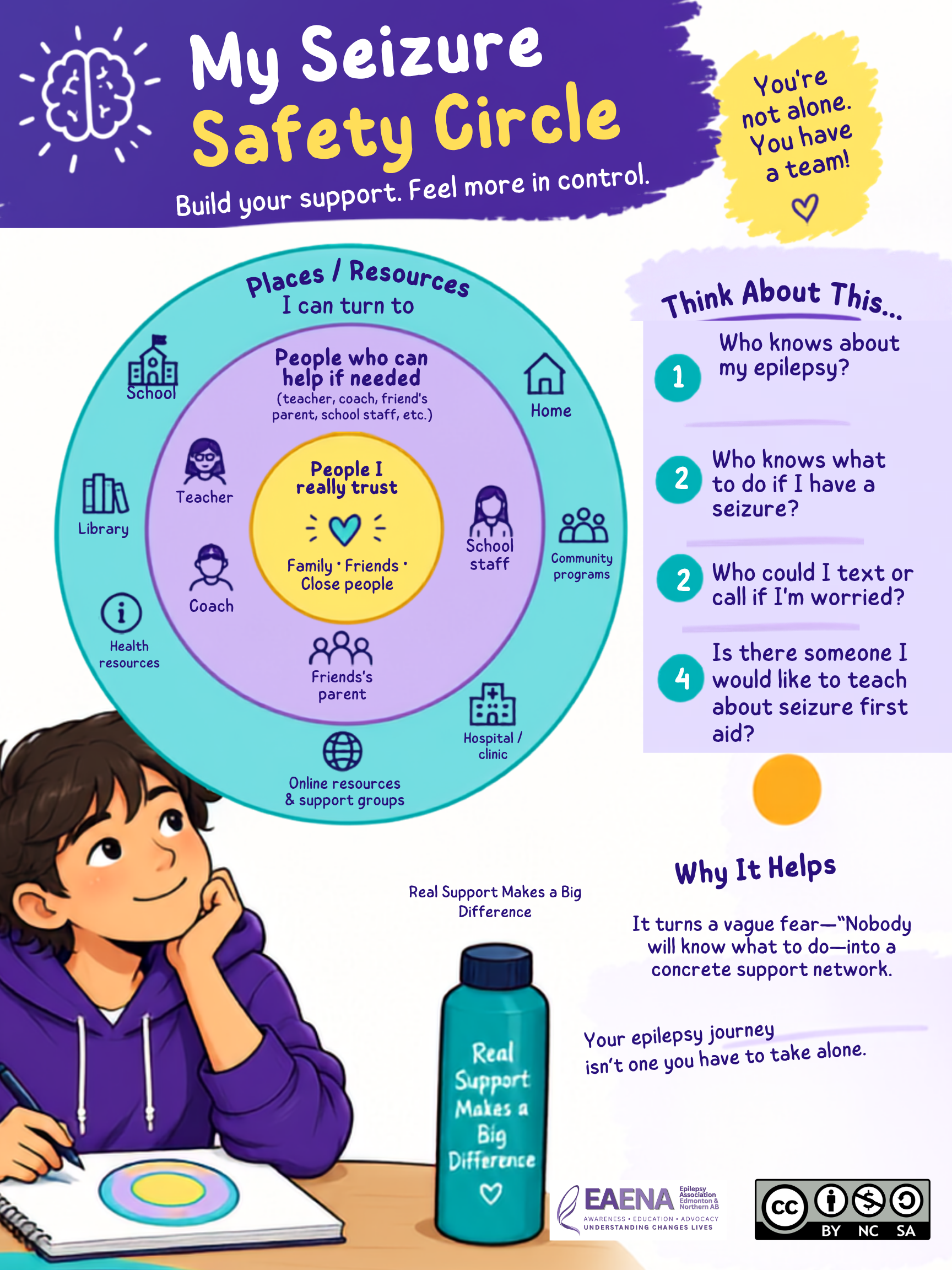
Why “My Seizure Safety Circle” Can Lower Stress and Confusion
Living with epilepsy can sometimes create the worry: “What if I have a seizure and nobody knows what to do?” This activity helps turn that worry into a plan.
- Makes support visible: Drawing the circles helps teens see that they have people and places they can turn to rather than feeling like they have to handle everything alone.
- Reduces uncertainty: Naming who knows about their epilepsy—and who knows seizure first aid—can replace “What if?” thoughts with a clearer plan.
- Creates a sense of control: Teens cannot always control when a seizure happens, but they can help build a support network around themselves.
- Identifies gaps: The activity can reveal if there is someone important who doesn’t yet know what to do. That creates an opportunity to teach them seizure first aid.
- Makes asking for help easier: Thinking ahead about “Who could I text or call?” gives the teen a specific person to contact when they are worried.
- Builds confidence and safety: Knowing that trusted people understand epilepsy can make school, activities, social situations, and being away from home feel less overwhelming.
The key message:
You may not be able to predict when a seizure will happen—but you can build a circle of people who are prepared to support you.
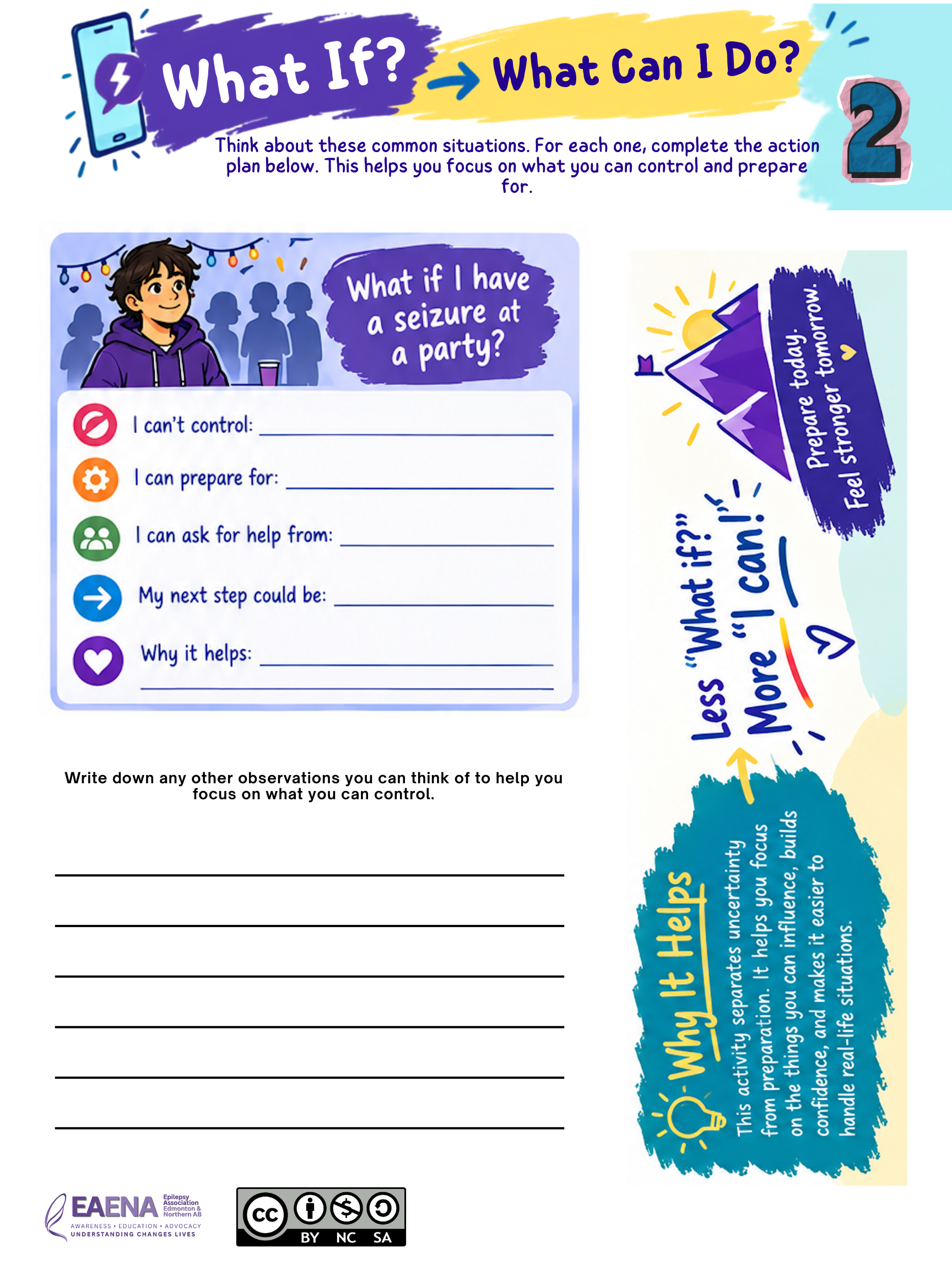
🧠 Why “What If?” → “What Can I Do?” Matters
- Reduces anxiety: Instead of repeatedly imagining everything that could go wrong, teens identify practical things they can do to prepare.
- Builds a sense of control: Epilepsy can involve uncertainty. Focusing on what they can influence can help reduce feelings of helplessness.
- Challenges catastrophic thinking: A thought such as “What if I have a seizure at school and everyone freaks out?” can become overwhelming. Breaking it into smaller steps makes the situation feel more manageable.
- Builds confidence: Having a plan—who to contact, what to prepare, and what the next step is—can help teens feel more capable of handling difficult situations.
- Encourages help-seeking: Identifying people they can ask for help reinforces that they don’t have to manage epilepsy or emotional distress alone.
- Reduces social fear: Concerns about staring, embarrassment, or having a seizure in public can lead some teens to avoid activities. Planning ahead may make participation feel safer.
- Supports emotional resilience: The exercise teaches a useful mental-health skill: I may not control everything that happens, but I can choose how I prepare and respond.
💜 The bigger message
The goal isn’t to eliminate every “What if?” thought. It’s to help teens move from “What if something goes wrong?” to “If something happens, I have a plan and people who can help me.”
That shift can reduce stress, increase confidence, and support a stronger sense of safety and independence.
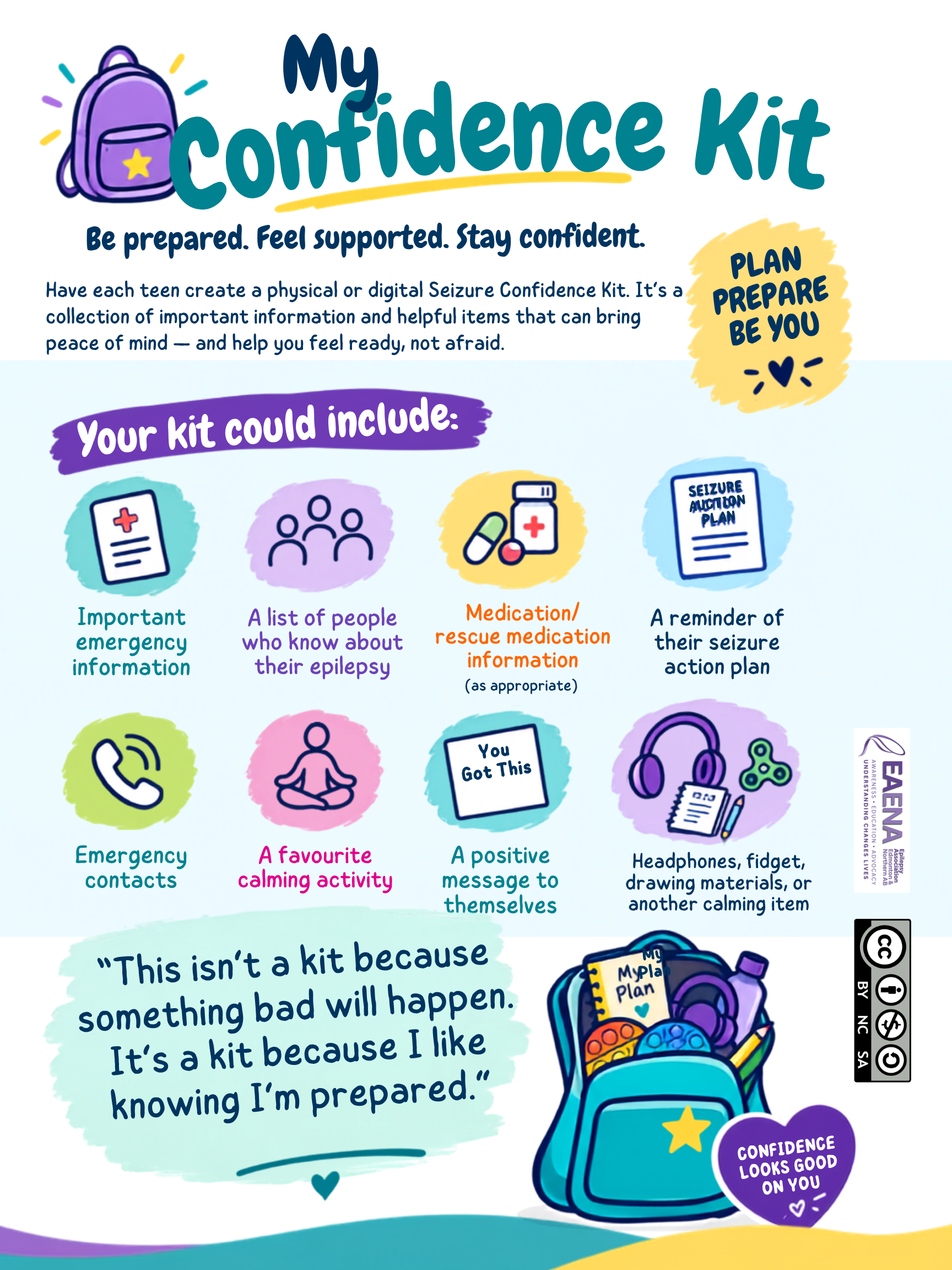
Why “My Confidence Kit” Is a Good Activity
Living with epilepsy can sometimes bring worry, uncertainty, stress, embarrassment, or fear about having a seizure in public. “My Confidence Kit” helps teens focus on what they can control and gives them practical tools to feel more prepared.
🧠 How this activity can support mental well-being:
- Builds confidence: Creating a personal kit helps teens recognize that they have strategies and resources available to them.
- Reduces uncertainty: Having important information, emergency contacts, and a seizure action plan in one place can make situations feel more manageable.
- Encourages a sense of control: Epilepsy can sometimes make teens feel that things are happening to them. Building their own kit gives them an active role in preparing for their needs.
- Supports emotional regulation: Including a favourite calming activity, headphones, a fidget, or drawing materials gives teens tools they can use when they feel stressed or overwhelmed.
- Strengthens support networks: Identifying people who understand their epilepsy reminds teens that they do not have to manage everything alone.
- Encourages positive self-talk: Adding a personal encouraging message helps shift the focus from fear to resilience and self-belief.
- Promotes independence: Teens can decide what information and items are useful to them, helping them develop confidence in managing epilepsy as they become more independent.
- Turns preparation into something positive: Instead of focusing on “What if something goes wrong?”, the activity encourages “I know what I can do, and I know who can help me.”
🌟 The key message
The goal isn’t to make teens think about seizures more or make them fearful. It is about replacing uncertainty with preparedness and fear with confidence.
“This isn’t a kit because something bad will happen. It’s a kit because I like knowing I’m prepared.”
This makes the activity especially useful as part of a mental-health and resilience program for youth living with epilepsy.